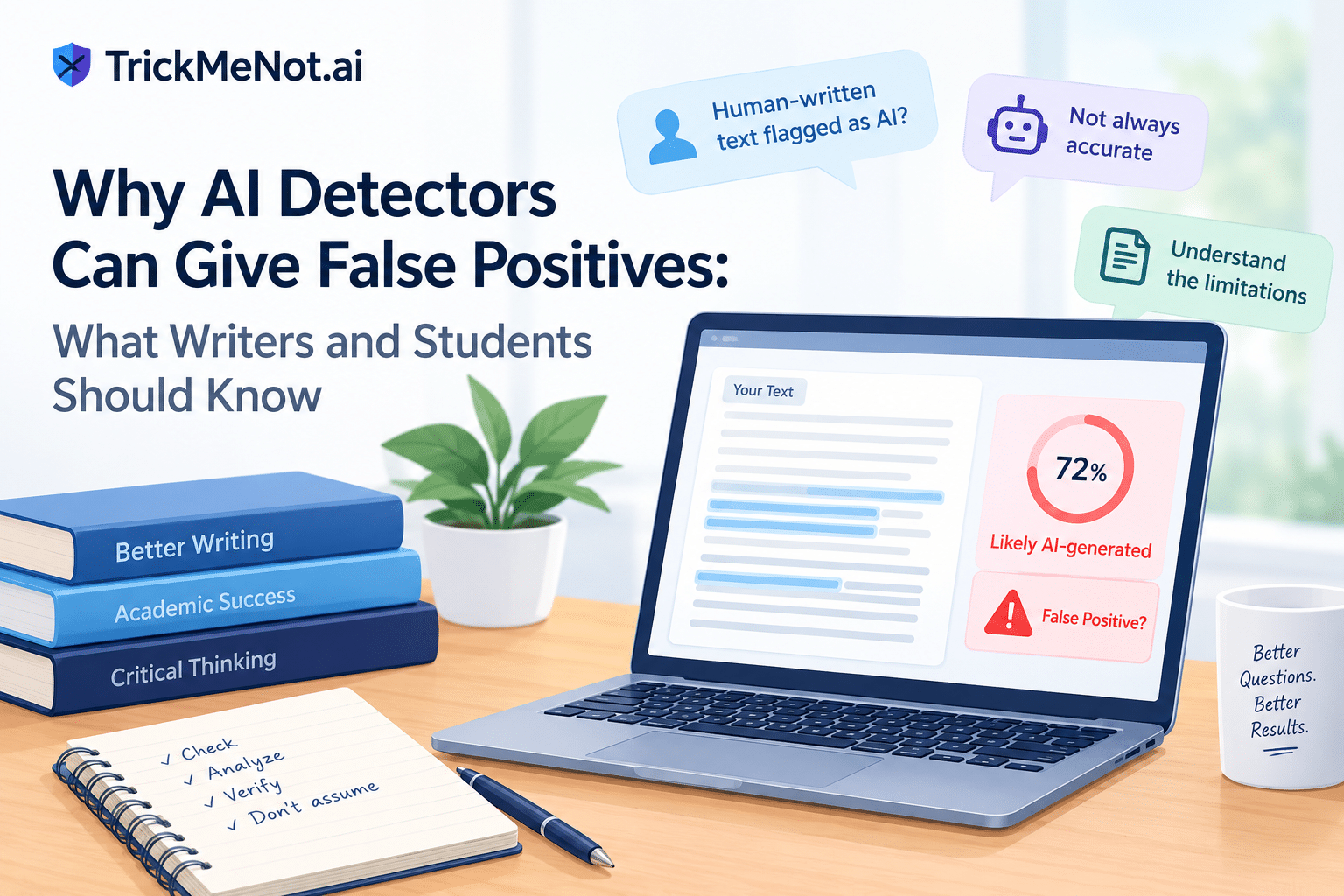
AI writing detectors are increasingly used to assess whether text may have been generated by artificial intelligence. However, their results are not always conclusive. A passage written by a person can sometimes receive an AI-generated classification, while AI-generated text may not always be identified correctly.
Understanding AI detector false positives is important for students, educators, writers, and content publishers. A detector score is an estimate produced by a tool, not definitive proof of who wrote a piece of text.
This guide explains why false positives happen, what can affect detection results, and how to interpret them responsibly.
Quick Answer
An AI detector false positive occurs when a detection tool incorrectly classifies human-written text as AI-generated. This can happen because AI detectors rely on statistical patterns in language rather than direct evidence of authorship. Short passages, predictable wording, formulaic writing, and the detector’s design may affect its output, although the impact varies by tool and text. A detector result should be treated as one limited signal, not conclusive evidence of misconduct.
Table of Contents
- What Is an AI Detector False Positive?
- Why Do AI Detectors Give False Positives?
- What Factors Can Affect AI Detection Results?
- False Positives vs. False Negatives
- What to Do If Your Writing Is Flagged
- Can AI Detector Scores Prove Authorship?
- How to Interpret AI Detection Results Responsibly
- Frequently Asked Questions
What Is an AI Detector False Positive?
A false positive occurs when a test identifies something as present when it is not.
In AI writing detection, this means a detector labels human-written text as AI-generated or assigns it a classification suggesting AI involvement when that conclusion is incorrect.
For example, imagine a student writes an essay independently using formal language, standard academic transitions, and a consistent sentence structure. An AI detector analyzes the essay and flags some of its passages as likely AI-generated.
That result does not establish that the student used AI. The detector may have identified patterns that overlap with those commonly associated with generated text.
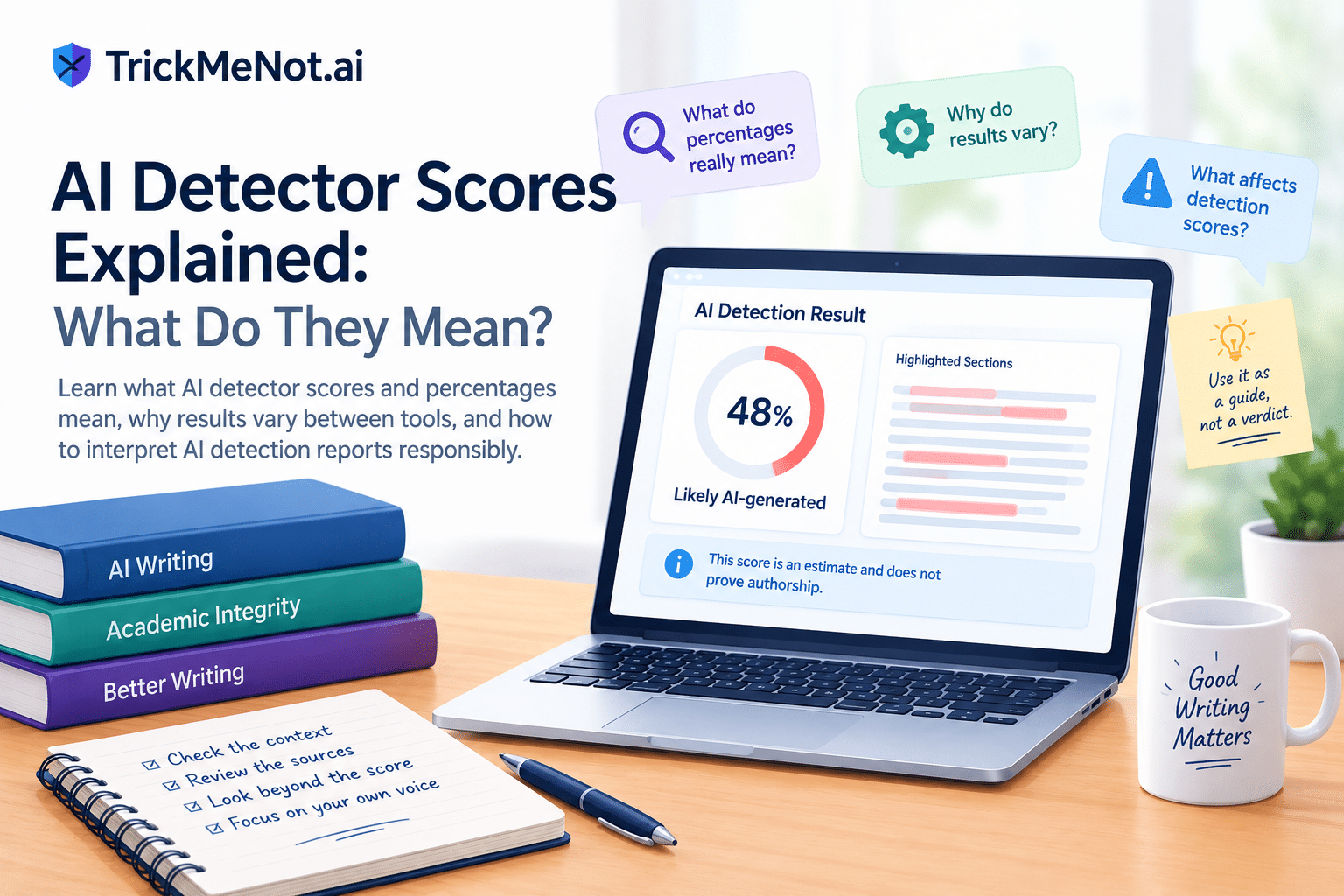
It is also important to distinguish between a false positive and a high detection score. A score is an output defined by the particular tool; it may represent a probability estimate, a classification, or another measure. Its meaning depends on the tool’s methodology and documentation.
Why Do AI Detectors Give False Positives?
There is no single explanation for every false positive. Different detection systems use different methods, and their limitations vary.
Several factors can contribute to incorrect classifications.
1. Human writing can follow predictable patterns
Many people write in conventional ways, particularly in academic, technical, and professional settings.
For example, a research summary might use formal vocabulary, familiar transitions, and carefully structured paragraphs. These features are not exclusive to AI-generated writing.
A detector that relies on statistical language patterns may struggle to distinguish some predictable human writing from generated text.
2. Formal and formulaic writing may be difficult to classify
Certain types of writing have strict conventions. Lab reports, textbook explanations, business documents, and structured essays may use standardized language because the format requires clarity and consistency.
That does not mean the text was produced by AI.
A formal style alone cannot reliably establish authorship, and a detector’s response to formal writing will depend on how its particular system was developed and evaluated.
3. Short passages provide limited evidence
A short paragraph contains less text for a detector to analyze than a longer document.
With fewer observations, a classification may be more sensitive to the particular words and sentence patterns in the passage. Some tools may also have minimum text requirements or limitations for particular document types.
For this reason, users should check the detector’s documentation and avoid treating the result from a small excerpt as a definitive judgment about an entire assignment.
4. Different tools use different detection methods
AI detectors are not interchangeable. They may use different models, features, thresholds, and evaluation methods.
Consequently, two tools can analyze the same passage and produce different results.
A disagreement does not automatically establish which result is correct. It highlights that detector output depends partly on the system performing the analysis.
5. Writing style varies across people and contexts
Writers have different levels of experience, vocabulary, and familiarity with a subject. Some naturally use concise sentences and common expressions; others write in a more varied or conversational style.
Language background and the type of text may also matter, depending on the detector and its evaluation data. Research has identified concerns about the reliability and fairness of some AI detection systems for certain groups of writers.
These issues should be evaluated using evidence about the specific tool rather than assumed to affect every detector equally.
What Factors Can Affect AI Detection Results?
The following table summarizes factors worth considering when interpreting an AI detection report.
| Factor | Why it matters |
|---|---|
| Text length | Short passages may provide limited evidence for classification. |
| Writing style | Conventional or highly structured prose may overlap with patterns a detector associates with generated text. |
| Document type | Academic, technical, and formulaic writing may differ from the text used to evaluate a tool. |
| Detector methodology | Different systems may use different models, thresholds, and scoring methods. |
| Language and evaluation data | Performance may vary across languages, writing contexts, and groups of writers. |
| Editing and revision | The final text may differ substantially from an initial draft, and detector performance on edited text can vary. |
These factors do not guarantee a false positive. They are reasons to interpret a detector’s result cautiously and consider the evidence available beyond the score.
False Positives vs. False Negatives
False positives and false negatives describe different kinds of classification errors.
| Term | Meaning in AI writing detection | Example |
|---|---|---|
| False positive | Human-written text is incorrectly flagged as AI-generated. | A student’s independently written paragraph receives an AI-generated classification. |
| False negative | AI-generated text is incorrectly classified as human-written or is not flagged. | A passage generated by AI receives no AI-generated flag from the tool. |
Both types of error matter when evaluating a detector’s reliability.
A tool that produces many false positives may unfairly raise concerns about human-written work. A tool that produces false negatives may fail to identify some AI-generated passages.
The balance between these errors depends on the system, its decision threshold, the data used for evaluation, and the text being assessed.
This is why accuracy claims should be examined in context rather than accepted as universal guarantees.
What to Do If Your Writing Is Flagged
If a detector flags your work, avoid assuming that the result automatically proves or disproves anything about authorship. Instead, review the situation methodically.
Step 1: Read the report carefully
Check what the tool actually reports. Determine whether it has classified the entire document, highlighted individual passages, or provided a score with a specific definition.
Do not assume that a percentage from one detector means the same thing as a percentage from another.
Step 2: Review your original work
If you wrote the document yourself, revisit your notes, outlines, research materials, and earlier drafts.
These materials can help explain how your work developed. If questions arise, genuine records of your writing process may be more informative than a detector score alone.
Step 3: Verify the content and citations
Review factual claims, quotations, paraphrases, and references. Confirm that sources support the statements attributed to them and that you have followed the applicable citation requirements.
For a related explanation of different checking methods, read TrickMeNot.ai’s guide to AI Detector vs. Plagiarism Checker.
Step 4: Follow the relevant policy
If this concerns an academic assignment, check your institution’s AI-use policy and the instructions for the specific assignment.
If an instructor raises a concern, ask which evidence and procedures are being used to evaluate the work. Explain your process honestly and provide relevant drafts or notes if appropriate.
Step 5: Avoid treating repeated scans as proof
Running the same passage through multiple detectors may produce conflicting results. Repeated scans do not necessarily resolve uncertainty because the tools may share limitations or use different methods.
Focus on understanding the report, verifying the work, and following the relevant review process.
Can AI Detector Scores Prove Authorship?
No. An AI detector score, by itself, cannot conclusively prove who wrote a document.
A detector estimates whether text exhibits patterns associated with AI-generated writing according to its own methodology. It does not directly observe the author’s writing process.
A responsible assessment may consider several sources of information, such as:
- Drafts, outlines, and revision history.
- Research notes and source materials.
- The writer’s explanation of their reasoning.
- Relevant assignment instructions and AI-use policies.
- The detector’s documented limitations and performance.
Not every situation requires all of these materials. The appropriate process depends on the circumstances and the applicable rules.
The central point is that a classification should not be confused with direct evidence of authorship.
How to Interpret AI Detection Results Responsibly
AI detection tools can be part of a broader review process, but their outputs need context.
Here are practical principles for students, educators, and publishers.
Understand what the score measures. Read the tool’s documentation before interpreting a number or label. Avoid assuming that every score represents the same probability.
Consider the tool’s limitations. Look for information about evaluation methods, false-positive rates, supported languages, and the types of text tested.
Separate detection from similarity checking. AI detection and plagiarism or similarity checking address different questions. A similarity report identifies matches against available sources, whereas an AI detector estimates whether writing resembles AI-generated text.
Avoid making decisions from a single score. When the consequences are significant, use a fair review process and consider relevant evidence beyond automated classification.
Be transparent about AI use. Follow the disclosure requirements established by your institution, employer, client, or publisher. Editing text does not automatically remove an obligation to disclose AI assistance.
For more background, see our guide on how AI detectors work.
Frequently Asked Questions
1. What is an AI detector false positive?
An AI detector false positive occurs when a tool incorrectly flags human-written text as AI-generated. It is a classification error, not proof that the writer used artificial intelligence.
2. Why does my human-written essay look AI-generated to a detector?
A detector may identify language patterns that overlap with those associated with generated text. Formal wording, predictable sentence structures, limited text, and the tool’s methodology may influence its output. The exact reason depends on the detector and the document.
3. Can AI detectors make mistakes?
Yes. AI detectors can produce false positives and false negatives. Their reliability varies across tools and writing contexts, so their results should be interpreted alongside other relevant evidence.
4. Does a high AI detection score prove that a student used AI?
No. A high score is not conclusive proof of authorship. Its meaning depends on the tool’s scoring method, and an assessment should account for the detector’s limitations and other available evidence.
5. Can plagiarism checkers detect AI-generated writing?
Plagiarism or similarity checkers and AI detectors generally serve different purposes. A similarity checker looks for matching text in sources available to it, while an AI detector estimates whether text exhibits patterns associated with generated writing. Some products offer both functions, but the results should be interpreted separately.
6. Are all AI detectors equally accurate?
No. Different tools use different methodologies and may perform differently across document types, languages, and evaluation conditions. Claims about accuracy should be assessed using evidence relevant to the particular tool.
7. What should I do if my teacher says my writing was flagged as AI?
Review the report, gather genuine drafts and notes that document your writing process, and follow your institution’s procedures. Ask for clarification about the evidence being considered and explain your process honestly. Do not rely solely on another detector’s score to settle the disagreement.
8. Can editing AI-assisted writing guarantee that a detector will not flag it?
No. No editing method can guarantee a particular detector result. Editing should focus on accuracy, clarity, original reasoning, and appropriate attribution—not on promising a specific classification from an automated tool.
Final Thoughts
AI detector false positives are an important limitation to understand when evaluating writing. A detector may provide useful information about patterns in a passage, but its output is not definitive evidence of authorship.
Students should retain genuine drafts and research notes, check their citations, and follow academic policies. Educators and publishers should consider the limitations of automated detection and use fair, evidence-based review procedures.
For more information, explore TrickMeNot.ai’s AI Detector vs. Plagiarism Checker guide and guide to understanding AI detectors.