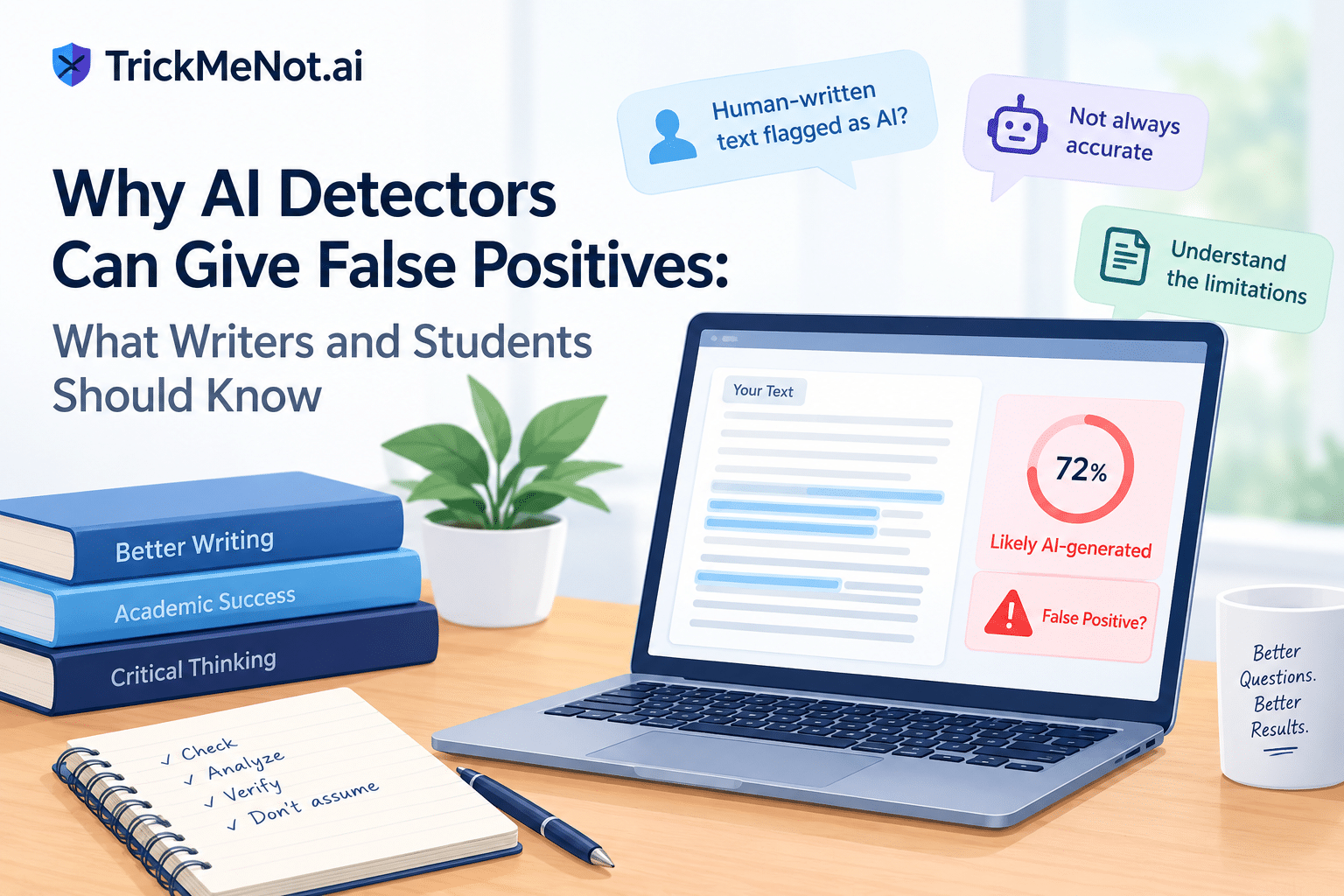
A free Turnitin alternative is a tool or combination of tools, that estimates the likelihood a piece of writing will be flagged as AI-generated or unoriginal, without the cost or institutional login Turnitin requires. Trickmenot’s Turnitin Score Estimator runs your text through three independent AI-detection engines (ZeroGPT, Quillbot, and Winston AI), averages the results, and gives you a single predicted “probability of human-written” score, free, in under a minute, with no account needed.
This isn’t a substitute for your school’s official Turnitin report. It’s a pre-submission sanity check so you’re not caught off guard by an AI-detection flag you didn’t expect.
Why Students and Writers Look for a Turnitin Alternative
Turnitin’s AI-writing indicator is not available to individual students — only institutions with a Turnitin license can generate an official similarity or AI report. That leaves a real gap: writers who want to check their own work before submission have no direct way to do it. Free multi-engine estimators fill that gap by approximating what a Turnitin-style scan is likely to flag.
Common reasons people use a score estimator instead of waiting for the official report:
- False-positive risk. AI detectors, including Turnitin’s own, have documented false-positive rates on non-native English writing and highly structured technical prose. Checking early gives you time to revise flagged sections.
- Heavily edited or AI-assisted drafts. Writers who used AI for outlining, grammar checks, or research want to confirm the final draft reads as their own voice.
- No institutional access yet. Freelancers, bloggers, and pre-enrollment students don’t have a Turnitin login at all.
Top AI Humanizers That Pass A.I. Detectors With EASE!
Stealth GPT
⭐ Most Consistent
✅ Affordable pricing and user-friendly features.
Undetectable AI
⭐ Most Aggressive
✅ Best for bypassing Originality AI
Walter Writes
⭐ Most Human Sounding
✅ Great readability and flow, best for writers
Frase
⭐ Best for SEO & Blog Optimization
✅ Great for ranking-focused writing and SERP insights
How the Free Turnitin Score Estimator Works
Trickmenot’s estimator doesn’t reverse-engineer Turnitin’s proprietary model (no free tool legitimately can, Turnitin’s detector isn’t public). Instead, it uses a consensus method across three established detection engines, each of which scores text using a different underlying signal:
| Engine | What it primarily measures | Best used for |
| ZeroGPT | Perplexity and burstiness patterns typical of LLM output | First-pass AI likelihood check |
| Quillbot AI Detector | Sentence-structure uniformity and paraphrase-pattern detection | Cross-checking ZeroGPT’s result |
| Winston AI | Sentence-level scoring with a per-sentence heatmap | Identifying which sentences are flagged, not just the overall score |
Step-by-step: how to use it
- Run your text through ZeroGPT and note the 0–100 AI-likelihood score.
- Run the same text through Quillbot’s detector for a second, independently-modeled score.
- Run it through Winston AI to see sentence-level flags, not just an aggregate number.
- Enter all three scores into the Turnitin Score Predictor below. The estimator averages them into a single “Probability of Human-Written” prediction — a rough proxy for what an institutional Turnitin scan is likely to show.
What the score actually means
Each engine returns a number from 0 (fully AI-flagged) to 100 (fully human-flagged). No single engine is authoritative — that’s why the estimator averages three. A wide spread between the three scores (for example, ZeroGPT at 20 and Winston AI at 75) is itself useful information: it usually means your writing sits in an ambiguous middle zone, which is common in edited or AI-assisted-then-revised text.
A low score isn’t a verdict — it’s a flag to review. Use Winston AI’s sentence-level heatmap to find which specific passages are triggering detection, then revise those sections for natural sentence-length variation, personal voice, and specific detail — the three things detectors consistently key on.

Turnitin Score Predictor
[Embed: interactive calculator — ZeroGPT Score / Quillbot Score / Winston AI Score inputs → Predicted Probability of Human-Written output]
Tools That Can Help You Reduce AI-Detection Flags
If your estimated score comes back high-risk, these tools are commonly used to revise AI-assisted drafts so they read with natural human variation — useful for legitimate editing, not for evading academic integrity checks on work that isn’t your own.
| Tool | Best For | Notable Strength |
|---|---|---|
| StealthGPT | Consistent, affordable revisions | User-friendly, predictable output across re-runs |
| Undetectable AI | Heavier rewrites | Strongest performance against Originality.ai specifically |
| Walter Writes | Long-form / creative writing | Highest readability and natural flow |
| Frase | SEO and blog content | Built-in SERP and ranking-focused optimization |
(Affiliate links — see our tool comparison directory for full reviews and independent scoring of each.)
Frequently Asked Questions
Is there a truly free Turnitin alternative? Yes. No free tool has access to Turnitin’s proprietary institutional database or its exact AI-detection model, but free tools like ZeroGPT, Quillbot, and Winston AI approximate the same underlying signals (perplexity, burstiness, sentence-pattern uniformity) that Turnitin’s AI-writing indicator uses. Combining several, as Trickmenot’s estimator does, gets closer to Turnitin’s likely output than any single free tool alone.
How accurate is a Turnitin score estimator compared to the real thing? It’s a directional estimate, not a guarantee. Independent testing of AI detectors consistently shows accuracy varies by writing style, subject matter, and language background, and no detector including Turnitin’s own, claims 100% accuracy. Treat the estimator’s output as a risk signal to investigate, not a confirmed result.
Can Turnitin detect AI-generated text with certainty? No. Turnitin publishes its own accuracy caveats and explicitly does not claim certainty on any individual document; it reports a percentage likelihood, similar in spirit to the estimator on this page.
Does this tool store or share the text I check? [Insert your actual data policy here — this is a required trust signal. State plainly whether text is stored, for how long, and link to your privacy policy.] See our Privacy Policy for full details.
Why do ZeroGPT, Quillbot, and Winston AI give me different scores for the same text? Each uses a different detection model trained on different data, so they weight signals like sentence-length variation and word predictability differently. A wide spread between scores usually means your text has mixed characteristics some very human-like passages and some more uniform ones, which is why Winston AI’s sentence-level breakdown is useful for pinpointing exactly where.
What should I do if my writing is flagged as AI-generated but I wrote it myself? This is a known false-positive scenario, especially for non-native English writers and technical/formulaic writing styles. Revise flagged sentences for more natural variation, keep drafts and version history as evidence of your writing process, and raise the false positive with your institution directly, most universities have an appeals process for AI-detection flags.
Related Reading
- How Turnitin’s AI Detection Works and Recent Updates
- Does Undetectable AI Actually Bypass Turnitin? What the Data Shows
- Do AI Detectors Store Your Uploaded Text?
- Free AI Text Humanizer Tool
- Free Essay Writer
- Full AI Detection & Humanizer Directory
Disclaimer: This tool provides an estimate only and is not affiliated with or endorsed by Turnitin LLC. Results should not be treated as equivalent to an official institutional Turnitin report. Always check your institution’s academic integrity policy.