Table of Contents
- What Is a Free Turnitin Alternative?
- What Can You Check With a Free Turnitin Alternative?
- What About AI Writing Detection?
- Can a Free Tool Replace Turnitin?
- Free Turnitin Alternative vs. Plagiarism Checker
- How Students Should Interpret a Similarity Score
- What Should You Check Before Submitting an Assignment?
- Free Writing Tools Can Be Useful at Different Stages
- A Simple Free Pre-Submission Workflow
- Frequently Asked Questions
- Final Thoughts
If you are looking for a free Turnitin alternative before submitting an assignment, the first thing to understand is what you actually need to check.
Students often use the terms plagiarism checker, similarity checker, originality checker, and AI writing detector as if they all perform the same job. They do not. Each type of tool can examine a different aspect of your writing, and understanding those differences can help you review an assignment more effectively.
A free tool can be useful as a pre-submission review step, but it should not automatically be treated as a replacement for your institution’s official Turnitin process.
What Is a Free Turnitin Alternative?
A free Turnitin alternative is an online tool that students can use to review their academic writing for issues such as text similarity, possible plagiarism, citations, grammar, or AI-writing patterns.
However, there is no universal definition of a “Turnitin alternative.” Different platforms use different databases, algorithms, and checking methods.
That means two tools can analyze the same essay and produce different results.
The most useful question is therefore not:
“Which tool gives me the lowest score?”
Instead, ask:
“What does this tool actually check, and how can the result help me improve my work?”
What Can You Check With a Free Turnitin Alternative?
Depending on the tool, a free alternative may help you review several areas of an assignment.
1. Text Similarity
Similarity checking looks for text that matches or resembles material available in the sources the system can access.
A similarity result does not automatically mean that plagiarism has occurred.
For example, properly cited quotations, commonly used phrases, titles, references, and correctly attributed material can contribute to matching text.
This is why students should review the highlighted sections instead of focusing only on a percentage.
2. Possible Plagiarism
Some plagiarism-checking tools attempt to identify potentially copied or insufficiently attributed content.
The result should be treated as a review signal rather than a final academic judgment.
If a section is flagged, check:
- Where the information came from
- Whether the source is properly cited
- Whether a quotation needs quotation marks
- Whether your paraphrasing genuinely reflects your understanding
- Whether the wording is too close to the original source
The goal is to produce properly attributed academic work—not simply to make a score disappear.
3. Citation and Source Review
A similarity checker can help you identify areas that deserve a closer look, but citation accuracy is a separate issue.
Before submitting, verify that:
- Sources are included where required
- In-text citations match your reference list
- Direct quotations are clearly identified
- Your required citation style is followed
- Sources actually support the claims you make
A low similarity score does not guarantee correct citations.
What About AI Writing Detection?
AI writing detection is different from similarity checking.
A similarity checker generally looks for matching or related text within the sources available to it. An AI-writing detector attempts to identify patterns that may be associated with machine-generated writing.
These are different tasks.
This distinction matters because a paper can have:
- Low text similarity but still require citation review
- High similarity because of correctly quoted material
- No obvious matching text but still contain AI-like writing patterns
- A detector flag despite being written by a person
For that reason, an AI detector should not be treated as proof that a student did or did not use AI.
Students should instead review their writing, verify sources, understand their institution’s AI policy, and make sure the submitted work accurately represents their own academic process.
Can a Free Tool Replace Turnitin?
Usually, you should not assume that it can.
Your institution may use Turnitin with its own database, settings, integrations, and academic workflows. A free third-party checker may use different sources and different detection methods.
This means the results are not necessarily interchangeable.
A better approach is to use a free tool as an additional pre-submission check.
For example:
- Complete your assignment.
- Review your sources and citations.
- Check the document with an appropriate writing or similarity tool.
- Investigate anything that looks unusual.
- Correct citation or writing problems.
- Review the complete assignment yourself.
- Follow your institution’s submission and academic-integrity requirements.
If you want a dedicated starting point, you can use the Free Turnitin Alternative on TrickMeNot.ai as part of your pre-submission review.
Free Turnitin Alternative vs. Plagiarism Checker
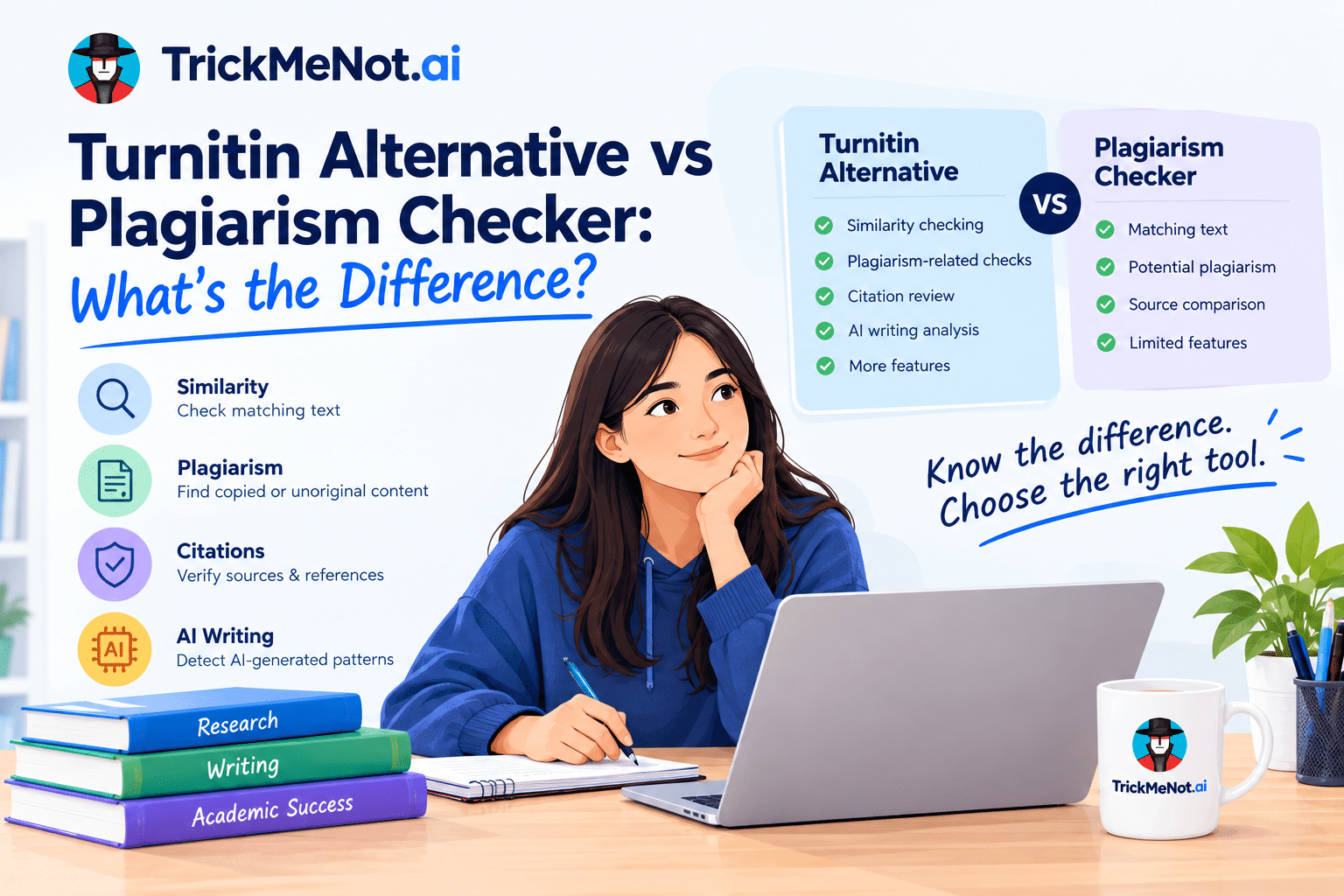
These terms are sometimes used interchangeably, but they can represent different expectations.
A plagiarism checker may focus primarily on identifying potentially copied or matching text.
A broader Turnitin alternative may attempt to provide several writing-related checks or combine different tools.
Before using any free tool, look for answers to questions such as:
- What sources does it check?
- Does it provide highlighted matches?
- Does it explain why text was flagged?
- Does it check citations?
- Does it analyze AI-writing patterns?
- Are there word or usage limitations?
- Does it require an account?
- Does it clearly explain its limitations?
Transparency is often more valuable than a tool simply advertising a high accuracy percentage.
How Students Should Interpret a Similarity Score
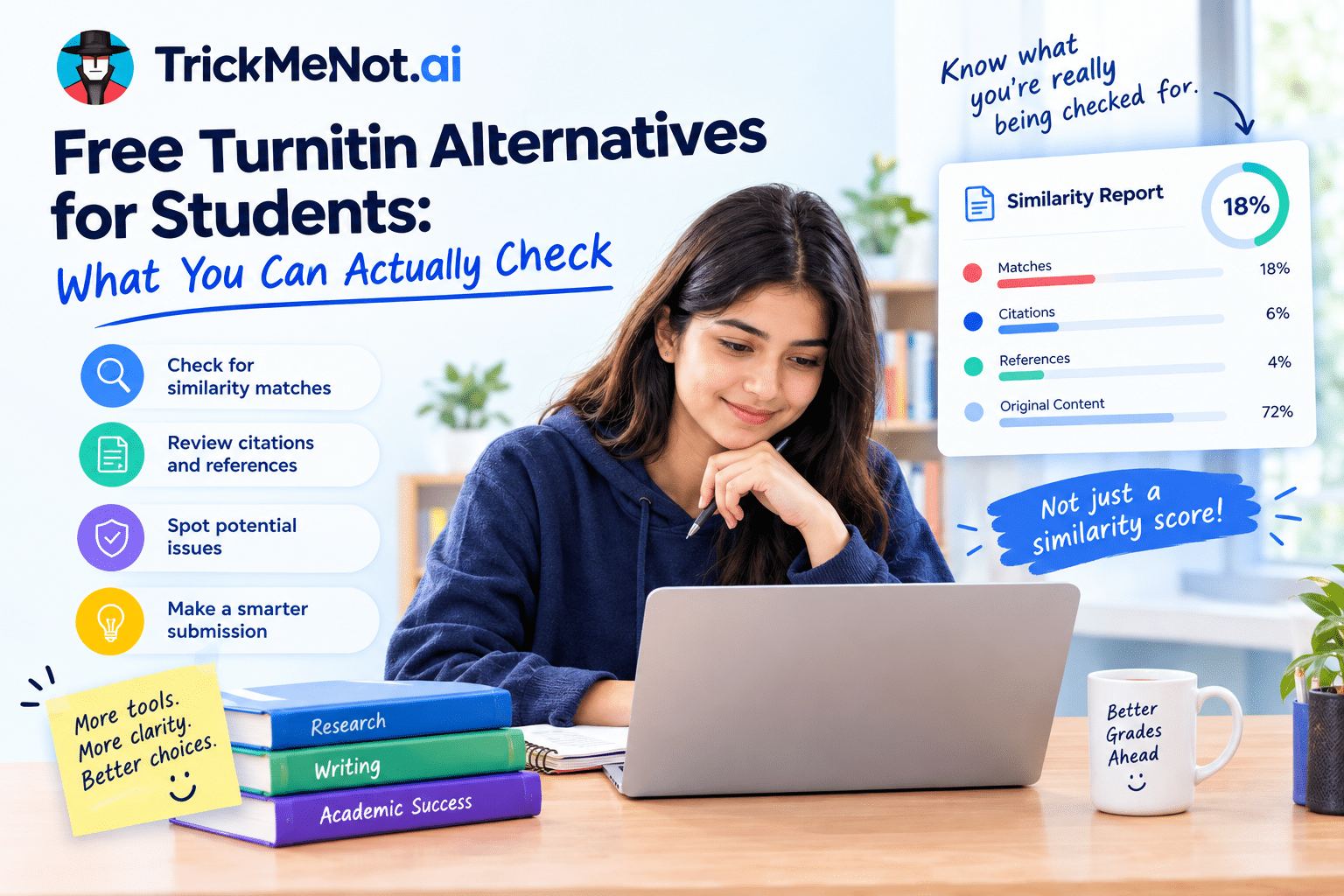
A similarity percentage is a starting point for review—not a final grade for originality.
Consider a simple example.
An assignment contains several correctly cited quotations. Those quotations may produce matching text, even though the student has used the material appropriately.
Another assignment might have a low similarity percentage but contain poorly cited ideas or sources.
This is why the number alone does not tell the whole story.
Instead, review the individual matches and ask:
Why was this text matched?
Is the source properly attributed?
Is this wording necessary?
Does the assignment follow the required citation style?
That process gives the result useful context.
What Should You Check Before Submitting an Assignment?
A good pre-submission review goes beyond plagiarism checking.
Check originality
Review sections that appear similar to existing sources and make sure borrowed ideas and wording are appropriately attributed.
Review citations
Confirm that your citations are complete, consistent, and formatted according to your assignment requirements.
Verify sources
Do not assume that an automatically identified source is reliable. Check important claims against the original source.
Improve clarity
Read the assignment from beginning to end. Look for repetitive sentences, unclear transitions, awkward wording, and unsupported claims.
Review your own voice
Your final draft should accurately represent your understanding and writing process. If you used AI tools where your institution permits them, follow the applicable disclosure and usage requirements.
Free Writing Tools Can Be Useful at Different Stages
A Turnitin alternative is only one part of a student’s writing workflow.
If you are still developing an essay, an AI Essay Writer can help you move from a blank page toward an organized starting point. Your own research, judgment, and revision should remain central to the final work.
If your draft contains repetitive or mechanical phrasing, a Free Text Humanizer can be used as part of a broader editing process. The purpose should be improving readability and natural expression rather than attempting to manipulate an academic detection system.
Students comparing different tools can also explore the AI Humanizer Tools Directory to understand different options and use cases.
A Simple Free Pre-Submission Workflow
You do not need to run your assignment through every available tool.
A practical workflow can be:
Write → Research → Cite → Review → Check → Edit → Submit
Start with the assignment itself.
Then verify your research and citations. Use an appropriate free checker for an additional review. Investigate flagged sections rather than blindly changing them. Finally, read the entire assignment yourself.
This approach is more useful than repeatedly checking the same document until a particular number changes.
Frequently Asked Questions
Are free Turnitin alternatives accurate?
Accuracy varies between tools and depends on what the tool checks, which sources it can access, and how its system works. Results should be interpreted as part of a broader review rather than as an unquestionable academic judgment.
Is a free plagiarism checker enough before submitting an essay?
It can be useful, but plagiarism checking alone is not enough. Students should also review citations, quotations, sources, grammar, clarity, factual claims, and their institution’s academic-integrity requirements.
Does a low similarity score mean an essay is plagiarism-free?
No. A similarity score only represents what the particular system identified as matching or similar. It does not automatically establish whether plagiarism has or has not occurred.
Can AI detection replace plagiarism checking?
No. AI-writing detection and plagiarism detection address different questions. They should not be treated as interchangeable.
Should students rely on one checker?
It is better to understand the limitations of the tool you are using rather than treating any single automated score as definitive. Your own review and your institution’s policies remain important.
Final Thoughts
Free Turnitin alternatives can be helpful when students use them as pre-submission review tools, not as magic score generators.
The most valuable result is not necessarily the lowest percentage. It is a clearer understanding of where your assignment needs attention—whether that means checking a source, correcting a citation, improving a sentence, reviewing a quotation, or verifying that your writing follows your institution’s requirements.
If you are comparing options, start with what you actually need to check and choose tools based on their purpose, transparency, and limitations.
For a broader comparison, see our guide to Best Affordable Turnitin Alternatives for Students.