AI writing tools have become part of the writing process for many students. They can help with brainstorming, organization, explanations, and drafting. At the same time, students may encounter AI detectors that attempt to estimate whether a piece of writing was produced or heavily assisted by an AI system.
But what exactly does an AI detector check? How does an AI detection score differ from a plagiarism or similarity score? And should students treat an AI detector result as proof that a text was written by AI?
The short answer is no: an AI detector result is an indicator, not the same thing as a traditional similarity or plagiarism report.
Understanding how AI detection works can help students interpret these tools more carefully before submitting academic work.
What Is an AI Detector?
An AI detector is a software tool designed to analyze writing for patterns that may be associated with AI-generated text.
Unlike a traditional plagiarism checker, an AI detector does not primarily look for matching phrases in a database. Instead, it analyzes characteristics of the submitted text and produces an estimate or indication of whether the writing resembles text generated by an AI system.
This distinction matters because AI detection and plagiarism detection answer different questions.
A plagiarism or similarity checker generally asks:
Does this text appear to match or resemble material found in available sources?
An AI detector generally asks:
Does this writing contain patterns that resemble AI-generated text?
These are different checks and should not be interpreted as interchangeable.
How Do AI Detectors Work?
AI detection systems can use different methods, and the exact technology depends on the tool.
At a general level, an AI detector may analyze patterns in the language, sentence construction, word choices, predictability, and other characteristics of the submitted writing.
The detector then uses these signals to estimate whether the text resembles AI-generated writing.
This means an AI detector is not simply searching for a copied sentence. It is evaluating characteristics of the writing itself.
Because different tools use different detection methods, two AI detectors can sometimes produce different results for the same piece of writing.
AI Detection Is Different From Plagiarism Detection
One of the most important things students should understand is that AI detection is not the same as plagiarism detection.
A plagiarism checker or similarity checker is generally concerned with relationships between submitted text and existing sources. A similarity result can help a student identify passages that may require quotation, citation, or further review.
AI detection has a different purpose. It attempts to determine whether the writing resembles text produced by an AI system.
For example, a paper could have:
- A low similarity score but still receive an AI-writing indication.
- A high similarity score because of correctly quoted or commonly used material.
- Both similarity matches and an AI-writing indication.
- Neither type of indication.
This is why students should review the different checks separately rather than treating one score as a complete measure of originality.
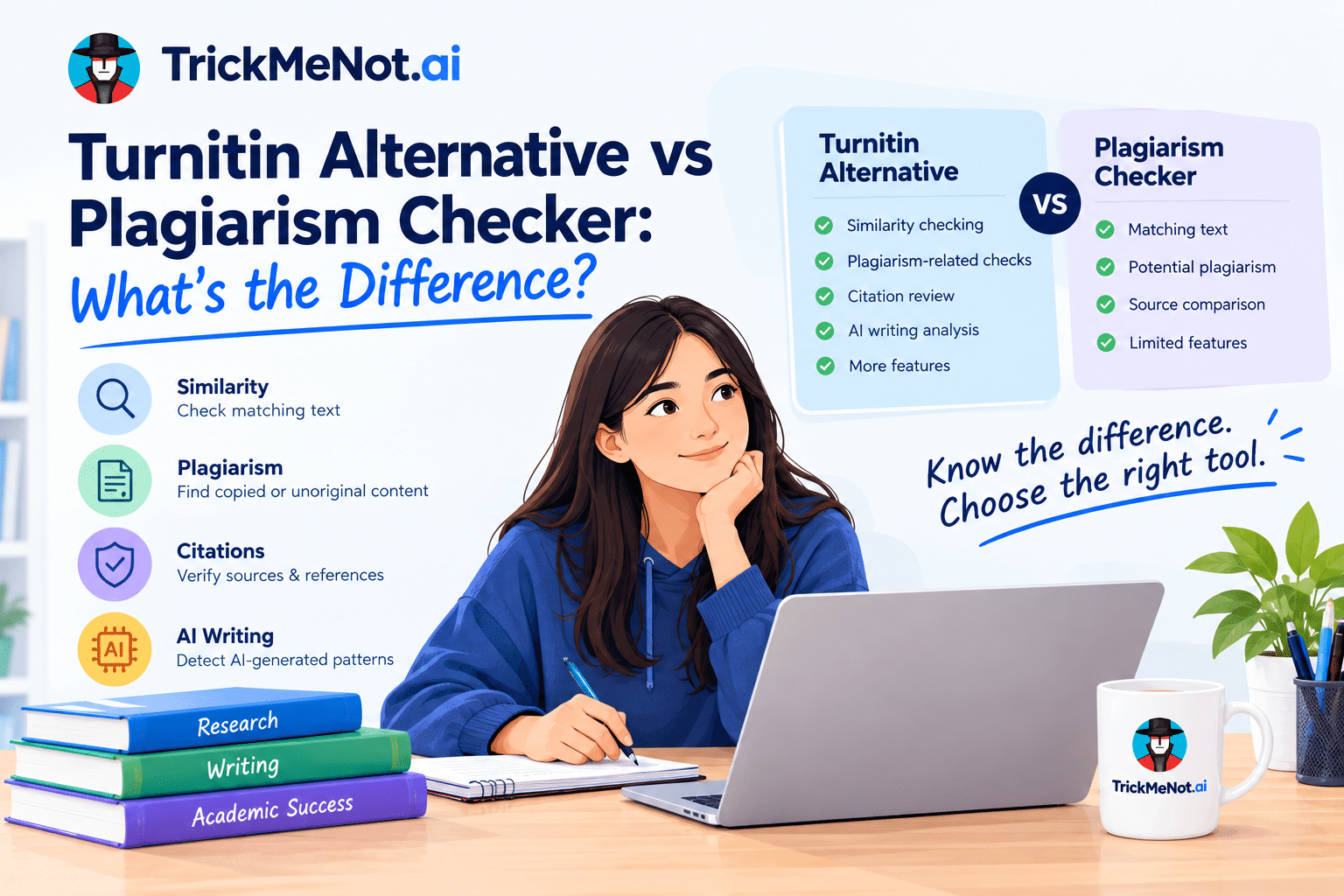
Your earlier comparison article explains this distinction in more detail: [Turnitin Alternative vs Plagiarism Checker: What’s the Difference?]
What Does an AI Detection Score Mean?
An AI detection score should be understood as an assessment or estimate generated by a particular tool.
The exact meaning of a score depends on the detector, its methodology, the type of text being analyzed, and the way the result is presented.
Students should therefore avoid treating a percentage as an absolute measurement of who wrote the text.
Instead, use an AI detection result as a signal that may justify reviewing the writing more carefully.
For example, if a tool highlights certain sections, a student can review those sections for:
- Generic or repetitive wording
- Unsupported claims
- Missing citations
- Inaccurate information
- Unclear explanations
- Writing that does not reflect their intended voice
- Statements that need additional research or evidence
The goal should be to improve the quality and integrity of the work rather than simply focusing on a single detector score.
Why Can AI Detectors Produce Different Results?
Different AI detectors can analyze writing differently.
One tool may identify certain linguistic patterns while another may use a different model or threshold. As a result, the same text can receive different results across different systems.
Writing style can also vary naturally.
Academic writing often contains formal language, structured sentences, repeated terminology, and discipline-specific vocabulary. These characteristics do not automatically mean that a text was generated by AI.
This is one reason an AI detection result should be interpreted carefully and in context.
Can Human-Written Text Be Flagged?
AI detection tools can produce results that require further review.
A detector’s result should not automatically be treated as definitive proof about the origin of a piece of writing.
Students should also remember that an academic submission is more than a detection score.
The quality of the argument, evidence, sources, citations, research process, and adherence to institutional policies all matter.
If a detector produces an unexpected result, reviewing the underlying writing and documentation can be more useful than repeatedly changing the text just to obtain a different score.
AI Detector vs Similarity Checker
The easiest way to understand the difference is to look at what each tool is designed to examine.
| Check | Main purpose | What students should review |
| Similarity check | Identifies text that resembles available sources | Matches, quotations, citations, paraphrasing |
| Plagiarism check | Helps identify possible unattributed use of existing material | Sources, attribution, quotations, references |
| AI writing detection | Estimates whether writing resembles AI-generated text | Writing patterns, highlighted sections, context |
| Citation check | Reviews references and citation-related issues | Sources, formatting, completeness |
These checks can complement each other, but one should not be treated as a replacement for another.
Your first article covers this broader pre-submission approach and explains what students can actually check with free Turnitin alternatives.
What Should Students Check Before Submission?
Instead of relying on one number, students can use a broader review process.
1. Review the Sources
Check whether important claims are supported by reliable sources.
Make sure references actually support the statements made in the assignment.
2. Review Citations
Look for missing citations, incorrectly formatted references, and claims that need attribution.
3. Review Similarity Matches
A similarity match is not automatically plagiarism.
Read the matched passages and determine whether the material is correctly quoted, cited, paraphrased, or commonly used.
4. Review AI-Writing Indicators Carefully
If an AI detector highlights sections, read those sections yourself.
Ask whether the writing is accurate, specific, clear, and genuinely represents the work you intended to submit.
5. Check Your Institution’s AI Policy
Different schools, colleges, and universities may have different rules regarding AI-assisted writing.
Before submitting an assignment, students should understand the relevant academic-integrity and AI-use requirements.
6. Review the Final Paper as a Whole
Read the complete assignment rather than focusing only on detector scores.
Check the argument, structure, evidence, citations, facts, grammar, and clarity.
Should Students Use an AI Detector Before Submission?
An AI detector can be one part of a broader writing-review workflow.
However, students should understand what the tool actually measures before interpreting the result.
A useful workflow can look like this:
Write → Research → Verify → Cite → Review Similarity → Review AI-Writing Indicators → Edit → Final Check → Submit
This approach is more useful than repeatedly changing individual sentences simply because a detector produces a particular result.
For additional pre-submission checking, you can also explore the Free Turnitin Alternative.
How AI Humanizers Fit Into the Writing Process
AI humanizers and AI detectors serve different purposes.
An AI humanizer generally focuses on rewriting or editing AI-assisted text so that it reads more naturally. An AI detector, on the other hand, analyzes writing for patterns that may resemble AI-generated content.
Students should not assume that changing wording automatically solves every writing issue.
The better approach is to review the content for accuracy, clarity, originality, citations, and compliance with academic requirements.
If you are working with AI-assisted writing, you can explore the Free Text Humanizer as part of a broader editing workflow.
You can also compare different tools through the AI Humanizer Tools Directory.
What About AI Essay Writers?
AI essay writers can assist with brainstorming, outlining, drafting, and organizing ideas, but students remain responsible for reviewing the resulting content.
AI-generated drafts may contain incorrect information, weak sources, generic explanations, or claims that require verification.
If you use an AI-assisted writing tool, review the content carefully and follow your institution’s rules regarding AI use.
For brainstorming and drafting assistance, you can explore the Free Essay Writer.
Common Mistakes Students Make With AI Detection
Mistake 1: Treating an AI score as proof
A detection score should be interpreted as an indicator produced by a particular tool, not as the entire story behind a piece of writing.
Mistake 2: Confusing AI detection with plagiarism
AI detection and plagiarism or similarity checking address different questions.
Mistake 3: Focusing only on percentages
A percentage without context does not explain why particular sections were identified.
Mistake 4: Ignoring citations
Changing wording does not remove the need to properly cite information taken from sources.
Mistake 5: Ignoring institutional policies
Students should always check their school’s or university’s rules before using AI-assisted writing tools.
A Practical Pre-Submission Checklist
Before submitting an assignment, ask yourself:
- Have I checked important facts and claims?
- Are my sources reliable and relevant?
- Have I included citations where required?
- Have I reviewed similarity matches?
- Have I checked potentially problematic paraphrasing?
- Have I reviewed any AI-writing indicators carefully?
- Does the final work follow my institution’s AI policy?
- Does the writing clearly communicate my own understanding of the subject?
- Have I completed a final proofreading and quality check?
This type of review provides more useful context than focusing on a single automated score.
FAQ
How do AI detectors work?
AI detectors analyze characteristics and patterns in writing that may resemble AI-generated text. The exact methods vary between tools, so results can differ.
Is an AI detector the same as a plagiarism checker?
No. A plagiarism or similarity checker primarily looks for relationships between submitted text and existing sources, while an AI detector estimates whether writing resembles AI-generated text.
What does an AI detection score mean?
An AI detection score is an estimate or indicator generated by a particular detection system. Its meaning depends on the tool and should be interpreted alongside the actual writing and other evidence.
Can AI detectors make mistakes?
AI detection results can require further review. Students should avoid treating one automated result as the complete explanation of how a piece of writing was produced.
Should I use an AI detector before submitting an assignment?
It can be used as one part of a broader review process. Students should also check sources, citations, similarity matches, accuracy, writing quality, and institutional AI policies.
Can an AI detector replace a plagiarism checker?
No. The two tools serve different purposes. An AI detector focuses on patterns associated with AI-generated writing, while a plagiarism or similarity checker focuses on relationships between submitted text and existing sources.
Final Thoughts
AI detectors are becoming part of the broader discussion around academic writing, but understanding what they actually measure is essential.
An AI detection result should not be confused with a plagiarism or similarity score. Each type of check addresses a different aspect of a student’s writing.
The most useful approach is to treat automated tools as part of a wider review process: verify information, check sources and citations, review similarity matches, understand AI-writing indicators, follow institutional policies, and carefully read the final work before submission.
For students looking for additional pre-submission resources, explore the Free Turnitin Alternative and other academic writing tools from TrickMeNot.ai.