Writing an academic assignment often involves using information from books, research papers, websites, and other sources. However, using someone else’s ideas without giving proper credit can lead to plagiarism concerns—even when the mistake is unintentional.
Many students understand that copying text is not acceptable, but they may be less familiar with the rules for paraphrasing, quotations, citations, and summarizing research.
Learning how to avoid unintentional plagiarism can help students produce clearer, more responsible academic work while protecting the originality of their own ideas.
In this guide, we’ll explain common citation mistakes, how to paraphrase correctly, and how to review your writing before submission.
Table of Contents
- What Is Unintentional Plagiarism?
- Common Causes of Unintentional Plagiarism
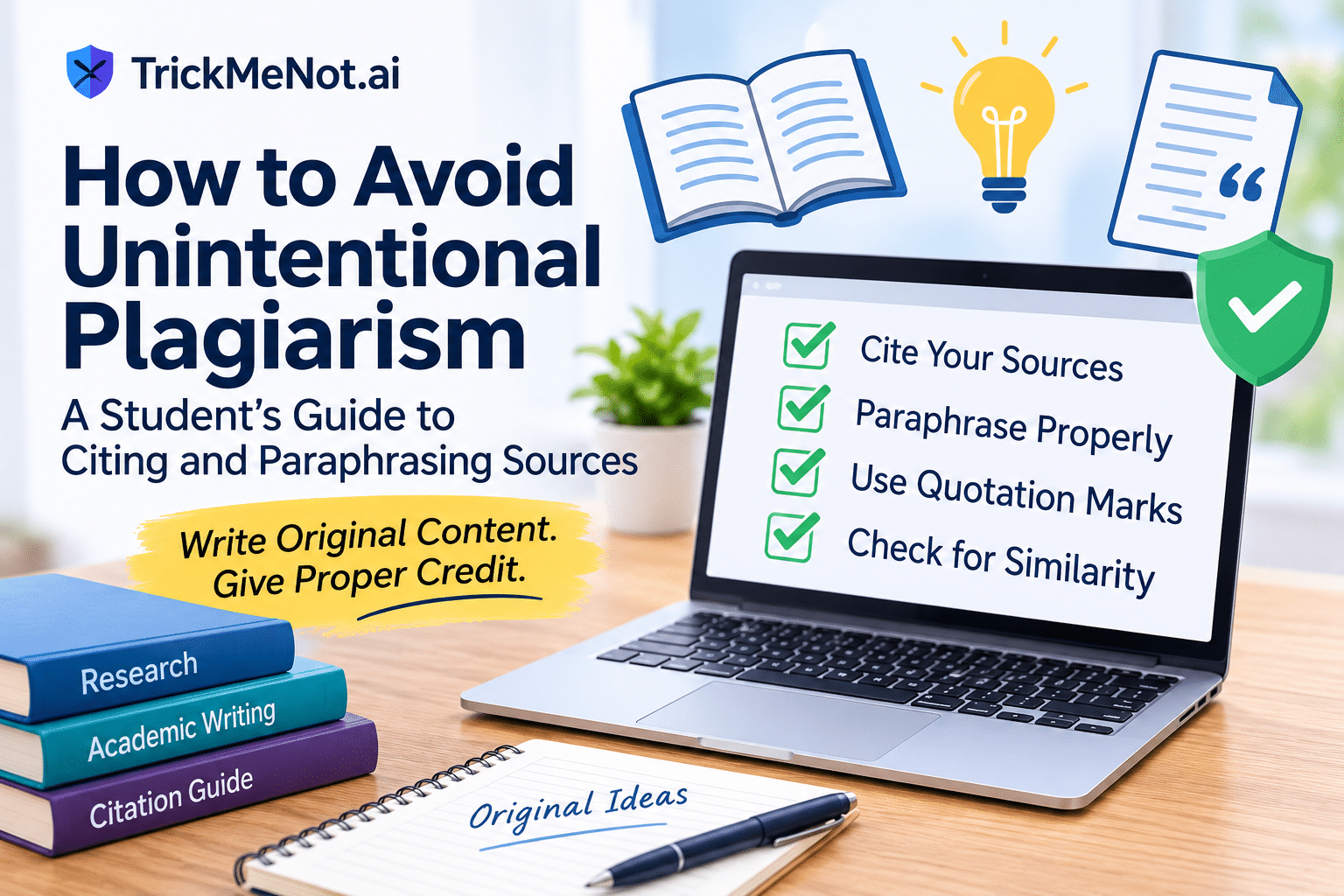
- How to Avoid Unintentional Plagiarism
- How to Paraphrase Sources Correctly
- Paraphrasing vs. Summarizing vs. Quoting
- How Similarity Checkers Can Help
- Common Citation Mistakes to Avoid
- Pre-Submission Checklist
- Frequently Asked Questions
1. What Is Unintentional Plagiarism?
Unintentional plagiarism occurs when someone uses another person’s words, ideas, research, or other intellectual contributions without providing appropriate acknowledgment.
Unlike deliberate copying, unintentional plagiarism may happen because a writer misunderstands citation rules, forgets to record a source, or incorrectly paraphrases information.
For example, a student might read a research article, take notes, and later include a sentence based closely on the original wording without quotation marks or a citation.
Even if the student did not intend to copy, the work may still create a plagiarism concern.
Unintentional plagiarism can involve:
- Using another author’s words without quotation marks.
- Paraphrasing too closely to the original source.
- Forgetting to cite borrowed ideas.
- Including statistics without identifying their sources.
- Reusing previously submitted work without permission where prohibited.
- Providing incomplete or incorrect references.
The best way to prevent these problems is to develop a consistent research, note-taking, and citation process.
2. Common Causes of Unintentional Plagiarism
Understanding why citation mistakes happen makes them easier to prevent.
Poor note-taking habits
Students sometimes copy sentences from research papers into their notes without clearly marking them as direct quotations.
Later, they may mistake those sentences for their own writing.
How to prevent it: Label copied passages as quotations immediately and record the author, publication, page number, or source location whenever available.
Incorrect paraphrasing
Changing a few words in an original sentence does not necessarily create an acceptable paraphrase.
If the sentence structure and wording remain too close to the source, the result may still be considered improperly paraphrased.
How to prevent it: Understand the original idea first, then explain it independently and cite the source.
Missing citations
Writers may remember to include a bibliography but forget to cite borrowed information within the main text.
A reference list alone does not always show which statements came from which sources.
How to prevent it: Add in-text citations while drafting instead of waiting until the end.
Confusion about common knowledge
Some facts are widely known and may not require citations in a particular academic context. However, specialized claims, research findings, statistics, and interpretations generally require appropriate sources.
How to prevent it: When uncertain, consult your assignment guidelines or ask your instructor whether a citation is necessary.
Rushing before submission
Completing research, writing, editing, and referencing at the last minute increases the likelihood of mistakes.
How to prevent it: Leave time for a separate citation and source-verification review before submitting your assignment.
3. How to Avoid Unintentional Plagiarism
The following practices can help you maintain accurate source attribution throughout your writing process.
1. Record your sources during research
Do not wait until the assignment is complete to collect reference information.
Whenever you use a source, record details such as:
- Author’s name.
- Article or book title.
- Publication name.
- Publication date.
- Page number, where applicable.
- DOI or URL, where applicable.
Keeping this information organized makes it easier to create accurate references later.
2. Separate your ideas from source material
Your research notes should clearly distinguish between your own thoughts and information taken from another author.
For example:
| Note type | Example |
|---|---|
| Your own idea | I think the study’s findings have practical implications for education. |
| Source information | The research paper reports a relationship between the variables being studied. |
| Direct quotation | An exact sentence copied from the source, clearly marked with quotation marks. |
This simple distinction can prevent accidental copying when you begin drafting.
3. Cite borrowed ideas
Citations are not limited to direct quotations.
If you use another author’s research, explanation, argument, or interpretation, you may need to cite that source even when you express the information in your own words.
Citation requirements depend on the academic style and assignment instructions.
Common citation styles include:
- APA.
- MLA.
- Chicago.
- Harvard.
Check which style your institution or instructor requires.
4. Use quotation marks for exact wording
If you reproduce a source’s exact words, identify them as a quotation and provide the appropriate citation.
Do not present copied wording as your own writing, even if the passage is relatively short.
Follow the relevant citation style for quotation formatting and page or location references.
5. Review your reference list
Before submitting your work, check that:
- Every required in-text citation has a corresponding reference.
- Reference details are accurate.
- Author names and publication dates are correct.
- URLs and DOIs work where applicable.
- Formatting follows the required citation style.
A well-organized reference list makes your research easier to verify.
4. How to Paraphrase Sources Correctly
Paraphrasing means explaining information from a source using your own wording and sentence structure while preserving the original meaning.
It is an important academic writing skill because it allows you to integrate research into your own explanation.
Consider this illustrative example.
Original sentence:
“Regular physical activity can contribute to improved concentration and overall well-being among students.”
Incorrect paraphrase:
“Frequent physical exercise can help improve concentration and general well-being in students.”
This version changes only a few words while keeping almost the same sentence structure.
Better paraphrase:
“Students may find it easier to maintain their focus and support their general well-being when physical activity is part of their routine.”
The revised example expresses the idea using a different structure. However, the original research still needs to be cited because the underlying idea comes from the source.
A practical paraphrasing process
- Read the original passage until you understand its meaning.
- Identify the central idea rather than focusing on individual words.
- Set the original passage aside.
- Explain the idea in your own sentence structure.
- Compare your version with the source to check accuracy and wording.
- Add the required citation.
Remember that paraphrasing does not remove the obligation to credit the original author.
5. Paraphrasing vs. Summarizing vs. Quoting
These three techniques help writers incorporate research into academic work, but they serve different purposes.
| Writing method | Meaning | Best used when |
|---|---|---|
| Paraphrasing | Restating a specific idea using your own words and structure. | Explaining a source’s point in the context of your argument. |
| Summarizing | Condensing the main ideas of a larger passage or source. | Presenting the overall findings or central argument. |
| Quoting | Reproducing the exact words of a source. | The original wording is particularly important or needs direct examination. |
All three methods generally require appropriate attribution when using another person’s work.
For a more detailed explanation of writing improvements, explore our guide on how to improve AI-assisted writing without losing your own voice.
6. How Similarity Checkers Can Help
A plagiarism or similarity checker can help writers review text matches against the sources available to the particular tool.
Depending on its features, a checker may identify:
- Matching phrases.
- Similar passages.
- Potentially uncredited text.
- Repeated wording.
- Source matches and references.
However, a similarity percentage does not automatically establish whether plagiarism has occurred.
For example, a report may include properly quoted material, references, common phrases, or correctly cited passages. These matches need to be reviewed in context.
Similarly, a low similarity score does not guarantee that every source has been acknowledged correctly.
What should you review in a similarity report?
When examining a report, pay attention to:
- Whether a matching passage has been quoted correctly.
- Whether the original source has been cited.
- Whether paraphrased material is sufficiently independent in wording and structure.
- Whether references and bibliography entries are being counted.
- Whether the report settings affect the displayed result.
You can learn more in our guide of Free Turnitin Alternatives for Students: What You Can Actually Check.
If you want to explore additional checking options, visit TrickMeNot.ai’s Free Turnitin Alternative page.
Keep in mind that third-party tools may use different databases and checking methods. They should not be assumed to produce the same report as Turnitin.
7. Common Citation Mistakes to Avoid
Even students who understand the importance of citations can make mistakes during research and writing.
Here are some common examples.
| Mistake | Why it is a problem | Better practice |
|---|---|---|
| Changing only a few words | The paraphrase may remain too close to the source. | Rewrite the idea using your own structure and cite it. |
| Forgetting in-text citations | Readers cannot easily identify where information originated. | Cite borrowed ideas in the relevant paragraphs. |
| Copying notes directly | Original wording may accidentally appear as your own. | Clearly label direct quotations in research notes. |
| Using incomplete references | Readers may struggle to locate the original source. | Verify all reference details. |
| Assuming a low similarity score means no plagiarism | Some attribution problems may not appear as text matches. | Review citations and source use manually. |
| Relying entirely on automated tools | Software cannot replace careful academic judgment. | Combine tool-assisted review with manual checking. |
8. Pre-Submission Checklist
Before submitting an assignment, use this checklist to review your work.
- Have I recorded all the sources used during research?
- Have I clearly separated my own ideas from borrowed information?
- Have I used quotation marks for exact wording?
- Have I paraphrased information using my own wording and sentence structure?
- Have I cited borrowed ideas and research findings?
- Have I checked the required citation style?
- Does every required in-text citation appear in my reference list?
- Have I verified author names, dates, titles, and source links?
- Have I reviewed any similarity report in context?
- Have I followed my institution’s academic integrity and AI-use policies?
This review can help identify common mistakes before submission, although it cannot guarantee that an assignment will receive a particular similarity score or academic evaluation.
9. Frequently Asked Questions
1. What is the easiest way to avoid unintentional plagiarism?
Keep accurate research notes, cite borrowed ideas, use quotation marks for exact wording, and paraphrase sources properly. Review your references before submitting your work.
2. Does paraphrasing prevent plagiarism?
Paraphrasing does not automatically prevent plagiarism. You must express the idea independently while providing appropriate credit to the original source.
3. Do I need to cite information even if I rewrite it in my own words?
Yes, when the idea or information comes from another source and requires attribution. Changing the wording does not remove the need for a citation.
4. Can a similarity checker identify every plagiarism issue?
No. Similarity checkers identify matching text against sources available to them. They may not identify every instance of unattributed borrowing, and their results require interpretation.
5. Does a high similarity score always mean plagiarism?
No. A similarity score measures matching text, not a definitive judgment about plagiarism. Proper quotations, references, common expressions, and other legitimate matches may contribute to the score.
6. Is unintentional plagiarism still a concern?
Yes. Even when a writer makes a citation mistake unintentionally, the work may still raise academic integrity concerns. Students should follow their institution’s policies and correct attribution errors whenever possible.
7. Can AI writing tools help with citations?
Some AI tools can suggest citation formats or help organize references, but their output may contain errors or invented details. Always verify citations against the original source and the required style guide.
8. What is the difference between plagiarism and similarity?
Similarity refers to matching text identified by a checking system. Plagiarism involves using another person’s work or ideas without appropriate acknowledgment. Similarity can indicate passages that need review, but the two terms are not interchangeable.
Final Thoughts
Avoiding unintentional plagiarism starts with good research habits and careful source management. Students should understand the difference between quoting, paraphrasing, and summarizing, and provide appropriate citations whenever they use another person’s work.
Similarity checkers can support the review process, but they should not replace manual source verification or an understanding of academic integrity.
The most reliable approach is to write with your own understanding, acknowledge the sources that inform your work, and review every citation before submission.
Explore more academic writing resources from TrickMeNot.ai: