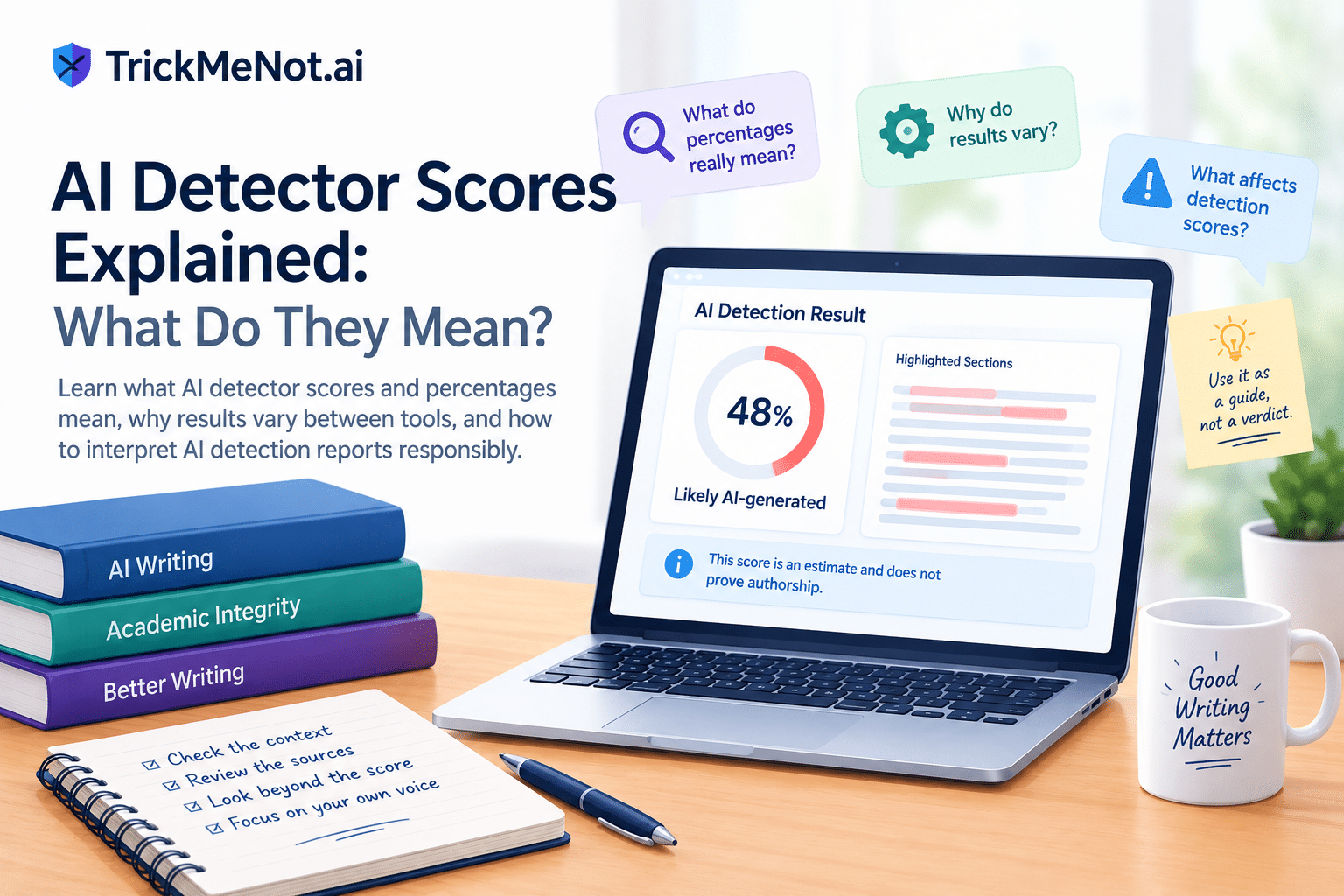
AI detector scores can be confusing. One tool may show a percentage, another may highlight specific sentences, and a third may provide a label such as “likely AI-generated.” These results can look similar, but they do not necessarily measure the same thing.
Understanding what an AI detector score represents—and what it cannot establish—helps students, educators, and content creators make more informed decisions.
Quick Answer
An AI detector score is an output generated by a particular detection system to estimate whether text matches patterns associated with AI-generated writing. Its meaning depends on the tool’s scoring method. A score of 70% should not automatically be interpreted as meaning that 70% of the text was written by AI. Check the tool’s documentation and treat the result as an estimate, not definitive proof of authorship.
Table of Contents
- What Is an AI Detector Score?
- What Do AI Detection Percentages Mean?
- Why Do Different AI Detectors Give Different Scores?
- AI Detection Scores vs. Plagiarism Scores
- What Can Affect an AI Detector Score?
- What to Do When a Detector Flags Your Writing
- Common Misconceptions About AI Detector Scores
- Frequently Asked Questions
1. What Is an AI Detector Score?
An AI detector score is a result produced by software that analyzes text for patterns associated with AI-generated writing.
Depending on the tool, the result might appear as:
- A percentage or numerical score.
- A label such as “likely AI-generated.”
- Highlighted sentences or passages.
- A classification indicating that text appears more likely to be AI-generated or human-written.
Not every detector uses the same approach. Some analyze an entire document, while others provide sentence-level or passage-level assessments.
Before interpreting a result, check what the specific tool measures and how it describes its output.
2. What Do AI Detection Percentages Mean?
The meaning of a percentage depends on the detector that produced it.
Consider this illustrative example:
| Detector result | What you should understand |
|---|---|
| 20% | The tool has produced a numerical result, but its precise meaning depends on the tool’s methodology. |
| 50% | The result should not automatically be interpreted as an equal split between human and AI authorship. |
| 80% | The result does not necessarily mean that 80% of the words were generated by AI. |
These figures are examples, not results from a real detector.
A percentage might represent a model’s estimate, a classification score, or another tool-specific measure. Without documentation explaining the scoring system, you cannot reliably translate that number into the proportion of a document written by AI.
Important: An AI detector score is not automatically a measurement of how much AI was used to create a document.
3. Why Do Different AI Detectors Give Different Scores?
Different detectors can produce different results for the same passage because their methods, training data, thresholds, and evaluation conditions may differ.
Several factors can contribute to these differences.
Different detection models
Each system may use its own approach to identify patterns in text. As a result, one detector may flag a passage while another does not.
Different scoring thresholds
Tools may use different thresholds to assign labels or classify writing. A similar underlying assessment could therefore lead to different displayed results.
Different text lengths
A short paragraph offers less text for analysis than a complete document. Some tools may also impose minimum text-length requirements.
Different writing styles
Formal, repetitive, or highly structured writing can overlap with patterns that some detectors associate with generated text. This does not establish that the passage was written by AI.
For more detail, read our related guide: Why AI Detectors Can Give False Positives.
4. AI Detection Scores vs. Plagiarism Scores
AI detection and plagiarism or similarity checking serve different purposes. Confusing their scores can lead to incorrect conclusions.
| Feature | AI detector | Plagiarism or similarity checker |
|---|---|---|
| Main purpose | Estimates whether text exhibits patterns associated with AI-generated writing. | Identifies text that matches material in the sources available to the tool. |
| Typical output | Classification, score, or highlighted passages. | Similarity percentage, matched passages, and source references where supported. |
| What it cannot establish alone | Definitive authorship. | Whether every match constitutes plagiarism or academic misconduct. |
| Important limitation | Results can include false positives and false negatives. | Results depend on available sources, settings, and matching rules. |
A high similarity score does not automatically prove plagiarism, just as a high AI detection score does not prove AI authorship.
Read our full guide to AI Detector vs. Plagiarism Checker for a more detailed comparison.
5. What Can Affect an AI Detector Score?
Several factors may influence the output of an AI detection tool.
- Text length: Short passages may provide limited information for classification.
- Writing style: Conventional sentence patterns may overlap with patterns the detector associates with generated text.
- Document type: Academic essays, technical explanations, and other structured documents may behave differently in evaluation.
- Language: Performance can vary across languages and writing contexts.
- Detector design: Models, thresholds, and scoring methods vary between products.
- Text revisions: Editing can change the text being analyzed, but the effect on detection results is not predictable or guaranteed.
These factors do not mean that every unexpected result is a false positive. They explain why the score should be interpreted in context.
For a broader explanation, see How AI Detectors Work.
6. What to Do When a Detector Flags Your Writing
If a detector flags your writing, review the result rather than relying on the number alone.
Step 1: Understand the report
Check whether the tool flags the entire document or particular passages. Read the documentation to understand what its percentage or label represents.
Step 2: Review your writing process
If you wrote the text yourself, retain genuine outlines, notes, drafts, and revision history where available. These materials may help explain how the document developed.
Step 3: Verify facts and citations
Check important claims against reliable sources and make sure quotations and citations are accurate. AI detection and source verification are separate tasks.
Step 4: Follow the relevant policy
If the document is an academic assignment, review your institution’s AI-use policy. If a concern has been raised, follow the established review process and explain your writing process honestly.
Step 5: Avoid relying on repeated scans
Running the same passage through several detectors may produce conflicting results. Multiple scores do not automatically establish which conclusion is correct.
The objective should be to understand the evidence and ensure that the work meets the relevant requirements—not to chase a particular percentage.
7. Common Misconceptions About AI Detector Scores
Misconception 1: A 70% score means 70% of the text was written by AI
Not necessarily. The number may represent a tool-specific score rather than the percentage of words generated by AI.
Misconception 2: A low score proves the writing is entirely human-written
A low score does not conclusively establish authorship. AI-generated writing may not always be flagged.
Misconception 3: All AI detectors should produce the same result
Different systems can use different methods and thresholds, so their results may vary.
Misconception 4: A high AI score proves academic misconduct
A score alone is not definitive evidence of authorship or a policy violation. Any assessment should follow the relevant institutional process and consider appropriate evidence.
Misconception 5: AI detection and plagiarism checking measure the same thing
They do not. AI detection estimates whether text resembles AI-generated writing, while similarity checking identifies matches against available material.
8. Frequently Asked Questions
What does an AI detector percentage mean?
It represents a result defined by the particular detection tool. You should consult the tool’s documentation before interpreting the percentage as a probability or any other specific measure.
Is 50% AI detection a mix of human and AI writing?
Not necessarily. A 50% result does not automatically mean that half the text was written by a human and half by AI. The meaning depends on the scoring method.
Can AI detectors give incorrect results?
Yes. Detectors can produce false positives and false negatives. Their reliability varies by tool and context.
Why do two AI detectors show different percentages?
They may use different models, data, thresholds, or scoring systems. Their percentages may not be directly comparable.
Can an AI detector score prove who wrote an essay?
No. A score alone cannot conclusively establish authorship. Drafts, notes, revision history, and the relevant review process may provide additional context.
Should I use an AI detector before submitting an assignment?
First, check your institution’s rules about AI tools. If detection tools are permitted and you choose to use one, treat the result cautiously and focus on the quality, accuracy, originality, and appropriate attribution of your work.
Final Thoughts
AI detector scores can provide an indication of how a particular tool classifies text, but they should not be interpreted without understanding the scoring method.
A percentage is not automatically the proportion of a document written by AI, and different detectors may produce different results for the same passage.
For students and writers, the most useful approach is to understand the report, verify the content, maintain appropriate writing records, and follow applicable policies.