
Table of Contents
- Quick Answer
- What Is a Plagiarism Checker?
- What Is a Turnitin Alternative?
- Turnitin Alternative vs Plagiarism Checker
- Is a Similarity Score the Same as a Plagiarism Result?
- Why a Low Similarity Score Doesn’t Prove Everything Is Correct
- What About AI Writing Detection?
- Can a Plagiarism Checker Replace a Turnitin Alternative?
- What Should Students Look for in a Turnitin Alternative?
- A Better Way to Use Plagiarism Checkers
- Free Tools Can Be Part of the Workflow
- Common Mistakes Students Make
-
Frequently Asked Questions
- Is a Turnitin Alternative the Same as a Plagiarism Checker?
- Which Is Better: a Plagiarism Checker or a Turnitin Alternative?
- Does a Plagiarism Checker Detect AI Writing?
- Does a Low Similarity Score Mean There Is No Plagiarism?
- Can Free Plagiarism Checkers Be Useful for Students?
- Should I Use a Turnitin Alternative Before Submitting an Assignment?
- Final Thoughts
When students search for a Turnitin alternative, they often end up comparing it with plagiarism checkers. The two terms sound similar, but they can describe different tools, different checking methods, and different purposes.
Understanding the difference matters because a similarity score, plagiarism report, and AI-writing result do not necessarily answer the same question.
If your goal is to review an assignment before submission, the better approach is to understand what each tool checks and use the result as part of a broader writing review.
Quick Answer
A Turnitin alternative is generally a tool that students may use to review academic writing for similarity, originality, citations, plagiarism-related issues, or other writing signals.
A plagiarism checker primarily focuses on identifying text that may match or closely resemble content in the sources available to the system.
The important point is that neither term guarantees that a tool works exactly like Turnitin.
Different tools can use different databases, matching systems, algorithms, and reporting methods. Therefore, students should compare what the tool actually checks, rather than choosing a tool simply because it advertises itself as a Turnitin alternative.
What Is a Plagiarism Checker?
A plagiarism checker is designed to help identify potentially matching or closely similar text.
Depending on the platform, it may compare submitted content against sources such as publicly available web pages, documents, or other indexed material.
The result can help you identify passages that deserve further review.
For example, a checker might highlight a sentence that resembles wording found elsewhere. That does not automatically mean the sentence represents plagiarism.
You still need to determine:
- Where the information originated
- Whether the source has been cited
- Whether the wording is a direct quotation
- Whether quotation marks are required
- Whether the paraphrasing is sufficiently independent
- Whether the source is appropriate for your assignment
In other words, a plagiarism checker can identify potentially problematic similarities, but the student still needs to understand the context.
What Is a Turnitin Alternative?
The phrase “Turnitin alternative” is broader.
Students may use it to describe an online service that provides one or more features associated with academic writing review.
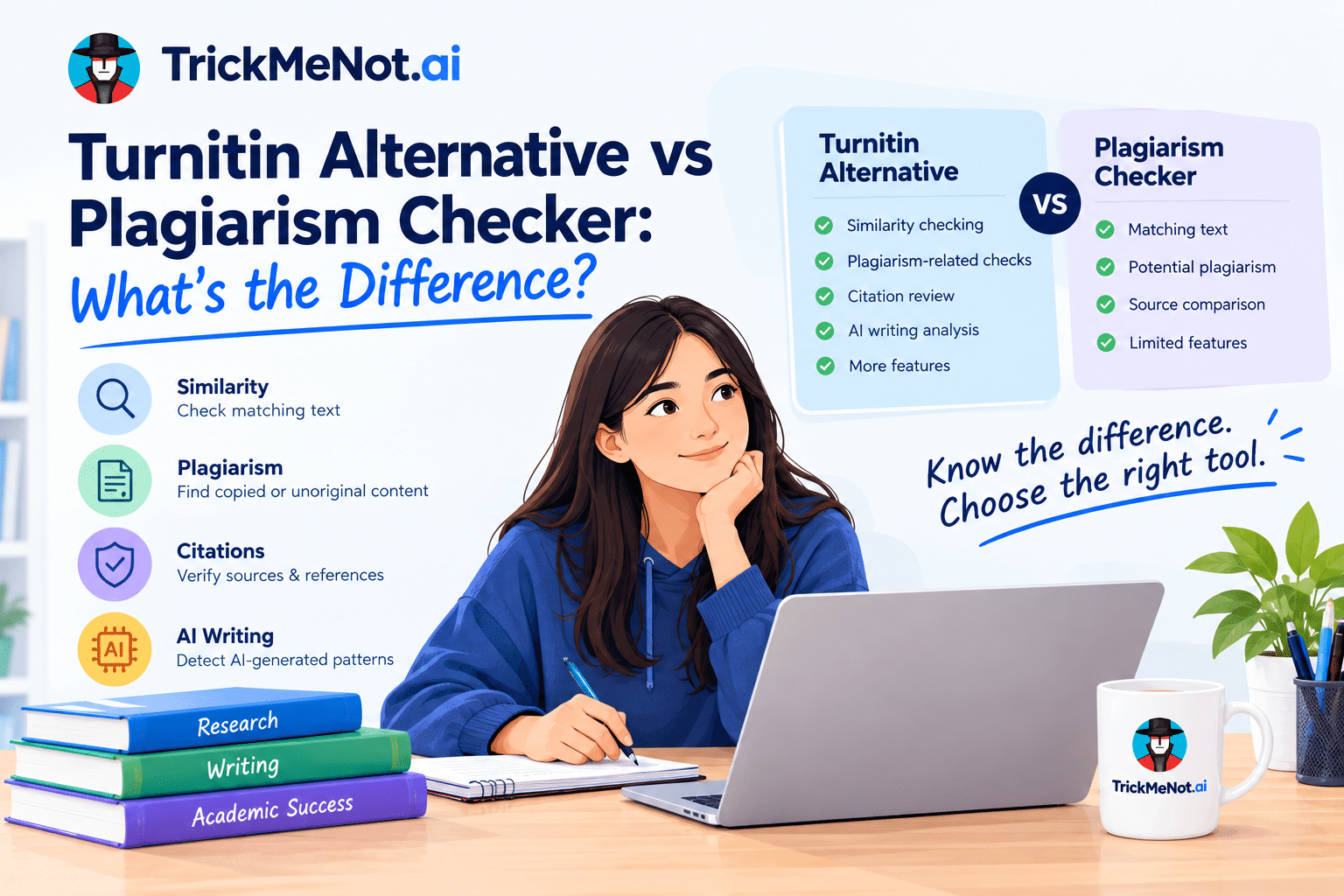
Depending on the specific tool, these features can include:
- Similarity checking
- Plagiarism-related checks
- Citation review
- Grammar and readability assistance
- AI-writing analysis
- Writing improvement tools
- Originality-related reports
However, not every Turnitin alternative offers every feature.
This is why comparing tools by their actual capabilities is more useful than comparing them by name alone.
If you are specifically looking for affordable options, our guide to Best Affordable Turnitin Alternatives for Students provides a broader starting point.
Turnitin Alternative vs Plagiarism Checker
The easiest way to understand the difference is to look at the purpose of each term.
| Feature | Turnitin Alternative | Plagiarism Checker |
| Similarity checking | May be available | Usually central to the tool |
| Potentially matching text | Often | Yes |
| Source review | Depends on the tool | Depends on the tool |
| Citation review | May be available | Not always |
| AI-writing analysis | Some tools offer it | Not necessarily |
| Grammar/readability | Some tools offer it | Usually not the primary purpose |
| Academic workflow | Depends on provider | Usually focused on checking |
| Results | Vary by tool | Vary by tool |
The key takeaway is simple:
A plagiarism checker is usually focused on matching or potentially copied text, while a Turnitin alternative may offer a broader set of academic-writing checks.
But always examine the individual tool’s features before assuming what it can do.
Is a Similarity Score the Same as a Plagiarism Result?
No.
This is one of the most important distinctions students should understand.
A similarity score generally indicates how much of a document has been identified as matching or similar to content within the system’s available sources.
It does not automatically determine that plagiarism has occurred.
Consider an assignment containing:
- Properly cited quotations
- Common academic terminology
- Bibliographic information
- Standard phrases
- Correctly attributed material
Some of this content may generate matching text.
That is why a similarity percentage should be investigated rather than treated as a final judgment.
What should you do when text is highlighted?
Instead of immediately rewriting everything, examine each highlighted section.
Ask:
- Is this my own wording?
- Is this a quotation?
- Is the source properly cited?
- Is the wording unnecessarily close to the source?
- Does my institution require a particular citation format?
- Does the passage need additional explanation or attribution?
This approach turns a similarity report into a writing-review tool.
Why a Low Similarity Score Doesn’t Prove Everything Is Correct
It can be tempting to assume that a low score means an assignment is completely safe.
That is not necessarily the case.
A checker only evaluates what its system can identify using its particular methods and sources.
A low similarity result does not automatically confirm that:
- Every source has been cited
- Every factual claim is accurate
- Every paraphrase is appropriate
- The assignment follows your institution’s rules
- The writing represents your actual understanding
- All academic-integrity requirements have been followed
That is why students should combine automated checking with manual review.
What About AI Writing Detection?
AI-writing detection introduces another layer that is separate from traditional plagiarism checking.
A plagiarism or similarity checker looks for matching or similar content.
An AI-writing detector attempts to identify patterns associated with AI-generated writing.
These are fundamentally different types of analysis.
For example, an essay could contain very little matching text but still receive an AI-writing signal from a particular detector.
Likewise, a document containing matching material may simply contain properly cited quotations or commonly used language.
Therefore:
Similarity detection ≠ plagiarism determination ≠ AI-writing detection.
Keeping these concepts separate helps prevent students from misunderstanding what an automated report actually means.
Can a Plagiarism Checker Replace a Turnitin Alternative?
It depends on what you need.
If your only goal is to identify potentially matching text, a plagiarism checker may be enough for that particular task.
But if you want a broader pre-submission review covering writing quality, citations, similarity, and other signals, you may need more than a basic plagiarism checker.
Think about your workflow rather than the product label.
If you need similarity checking
Look for a tool that explains matching text and provides enough information to investigate the result.
If you need citation review
Choose a workflow that allows you to verify sources and citation formatting separately.
If you need writing improvement
A writing tool can help you identify unclear, repetitive, or awkward passages.
If you need AI-writing analysis
Treat the result as one signal rather than definitive proof.
If you need all of these
Look for a combination of tools that addresses each task without assuming that one automated score can answer every question.
What Should Students Look for in a Turnitin Alternative?
Instead of choosing a tool based only on the phrase “Turnitin alternative,” evaluate it using a few practical criteria.
1. What does it actually check?
Read the tool’s feature description carefully.
Does it check similarity? Web sources? Citations? AI-writing patterns? Grammar?
Do not assume that every “originality checker” performs the same analysis.
2. Does it explain the result?
A percentage without context is difficult to interpret.
Useful results should help you understand which sections need attention and why.
3. Does it explain limitations?
No automated checker should be treated as infallible.
Look for transparent explanations about what the system can and cannot determine.
4. Does it support better writing?
The most useful pre-submission workflow is not simply about lowering a number.
It should help you identify areas where your writing, citations, research, or structure could be improved.
5. Does it fit your institution’s requirements?
Your college, university, or school may have specific rules concerning plagiarism checking, AI assistance, citations, and academic integrity.
A third-party tool does not replace those requirements.
A Better Way to Use Plagiarism Checkers
Students can get more value from a plagiarism checker by using it near the end of the writing process rather than treating it as the entire review.
Try this workflow:
Write → Research → Cite → Review → Check → Investigate → Edit → Final Review
Step 1: Complete your draft
Focus first on developing your ideas and completing the assignment.
Step 2: Verify your sources
Check that important claims are supported by appropriate sources.
Step 3: Review citations
Make sure quotations, paraphrased ideas, and borrowed information are properly attributed.
Step 4: Run an appropriate checker
Use a plagiarism or similarity checker as an additional review step.
Step 5: Investigate matches
Do not automatically rewrite every highlighted section.
Determine why it was flagged.
Step 6: Improve the draft
Fix genuine citation problems, unclear wording, weak paraphrasing, or unnecessary repetition.
Step 7: Read the final version yourself
A manual review remains important because automated systems cannot fully understand your assignment’s context, purpose, and academic requirements.
Free Tools Can Be Part of the Workflow
Students who want a free starting point can explore a Free Turnitin Alternative as part of their pre-submission review.
If the main problem is repetitive or mechanical wording, a Free Text Humanizer can be used as an editing aid to improve readability and natural expression.
If you are starting an essay from scratch, the Free Essay Writer can help with early-stage writing and idea development.
And if you want to compare different AI writing and humanization tools, the AI Humanizer Tools Directory provides a broader discovery resource.
These tools serve different purposes, so they should not be treated as interchangeable.
Common Mistakes Students Make
Mistake 1: Treating every percentage as a plagiarism score
A percentage is not a complete academic judgment.
Always examine the underlying matches and context.
Mistake 2: Assuming every Turnitin alternative has the same database
Different services can have access to different sources.
That can lead to different results for the same document.
Mistake 3: Using an AI detector as proof
AI-writing detection is a separate type of analysis and should not automatically be interpreted as definitive.
Mistake 4: Rewriting everything that gets flagged
Some matching text may be legitimate.
Review the source and citation before changing the wording.
Mistake 5: Ignoring institutional policy
Your institution’s academic-integrity policy should remain the primary reference for submission requirements.
Frequently Asked Questions
Is a Turnitin alternative the same as a plagiarism checker?
Not necessarily. A plagiarism checker generally focuses on potentially matching or copied text, while a Turnitin alternative may offer a wider range of academic-writing review features.
Which is better: a plagiarism checker or a Turnitin alternative?
Neither is automatically better. The right choice depends on what you need to check. If you primarily need similarity analysis, a plagiarism checker may be sufficient. If you want multiple types of writing checks, a broader tool may be more useful.
Does a plagiarism checker detect AI writing?
Not necessarily. Traditional plagiarism checking and AI-writing detection are different types of analysis. Check the specific tool’s features rather than assuming it provides both.
Does a low similarity score mean there is no plagiarism?
No. A similarity score is only one part of the review process. You should also examine citations, paraphrasing, sources, quotations, and your institution’s academic-integrity requirements.
Can free plagiarism checkers be useful for students?
Yes. A free checker can provide an additional review before submission. However, students should understand the tool’s limitations and should not assume that its results are identical to their institution’s official checking system.
Should I use a Turnitin alternative before submitting an assignment?
It can be useful as a pre-submission review step. Use it to identify areas that deserve attention, then verify your sources, citations, writing, and compliance with your institution’s requirements.
Final Thoughts
The difference between a Turnitin alternative and a plagiarism checker comes down to purpose and scope.
A plagiarism checker generally helps identify potentially matching text. A Turnitin alternative may provide a broader set of academic-writing checks, depending on the platform.
Neither should be reduced to a single number.
For students, the most useful workflow is to combine automated checking with careful human review. Check your sources, verify citations, investigate matching text, improve unclear writing, and follow the academic-integrity rules that apply to your assignment.
If you are comparing affordable options, continue with our guide to Best Affordable Turnitin Alternatives for Students: What to Check Before You Submit.
