
Misinformation spreads fast, especially in diplomatic talks. AI detection in diplomatic communications helps find false or misleading data before it causes harm. In this blog, you’ll learn how AI tools can boost trust and protect sensitive conversations.
Keep reading—it gets interesting!
Key Takeaways
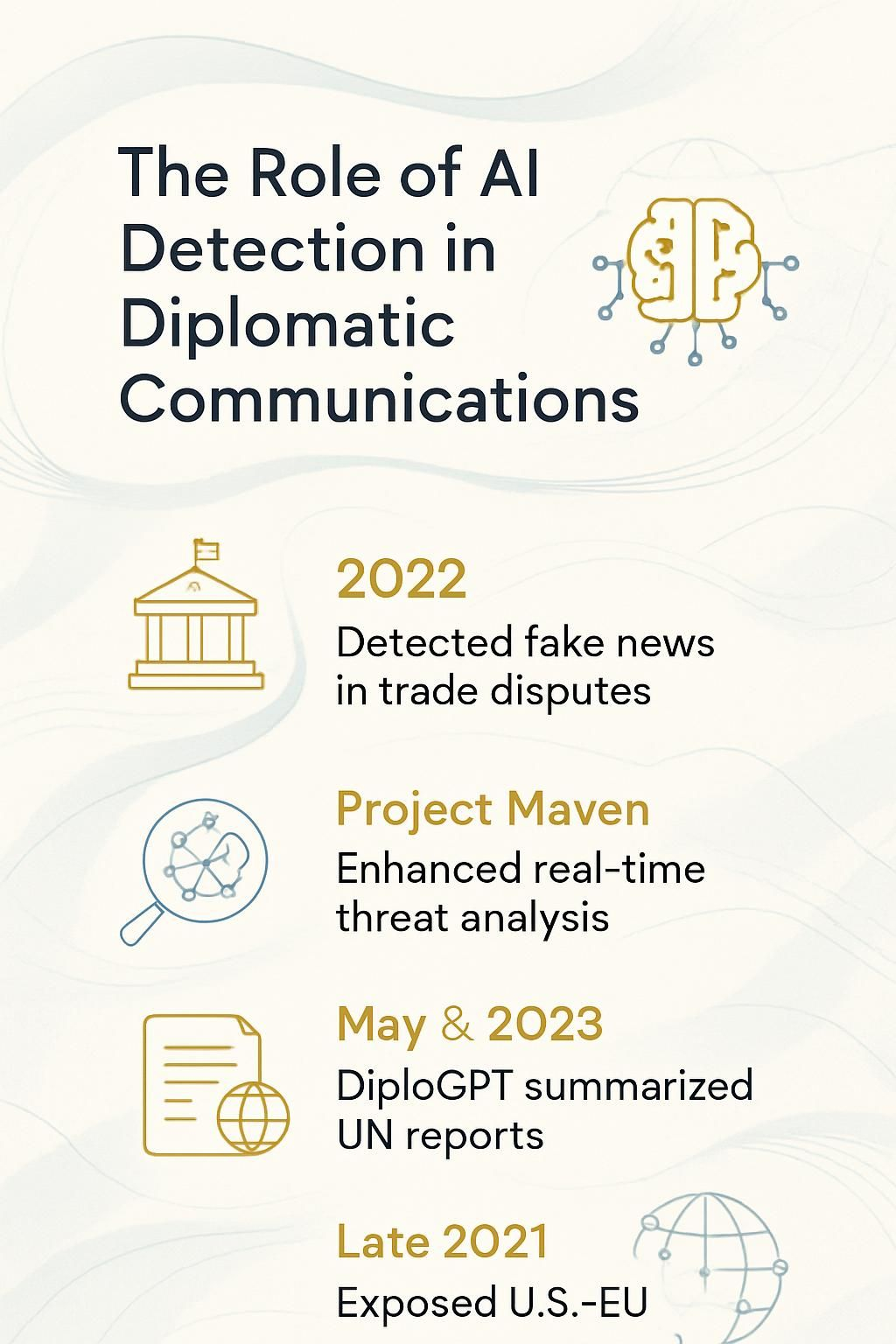
- AI tools like predictive analytics and machine learning detect fake news, misinformation, and deepfakes in diplomatic talks to prevent conflicts. Examples include spotting fake stories during the U.S.-China trade disputes in 2022.
- Projects like Project Maven from the U.S. Department of Defense use AI for real-time threat analysis, improving decision-making speed and accuracy in critical scenarios.
- Generative AI improves communication by ensuring clear translations during international negotiations, reducing risks of misinterpretation across languages.
- Ethical issues like bias in AI data or GDPR compliance create challenges. Human oversight is vital to ensure fairness and prevent misuse of automated decisions.
- Case studies show success: DiploGPT summarized UN reports (May 3, 2023), while predictive models exposed espionage attempts against U.S.-EU communications (late 2021).
The Role of AI Detection in Modern Diplomatic Exchanges
Modern diplomacy uses AI detection tools to keep talks honest and accurate. These tools scan huge amounts of data in seconds, spotting lies or twisted truths faster than any human could.
For example, predictive modeling helps diplomats prepare for shifting geopolitical dynamics by giving real-time insights on threats or chances for agreement.
Tools like generative AI also improve international relations by analyzing language translation during diplomatic negotiations. Misinterpretation can derail talks entirely, but AI ensures clear communication between parties with different languages and cultures.
The U.S. Department of Defense’s Project Maven highlights the power of such technology in decision-making processes that demand speed and precision in critical moments.
Identifying Misinformation in Diplomatic Communications Using AI
AI tools are critical in spotting lies and fake news in diplomatic talks. Generative AI, while helpful, can create risks by spreading false information quickly. Deepfake videos and altered images have become tools for misinformation campaigns, often targeting international relations.
Machine learning models analyze patterns to detect such fakes before they cause harm.
Tools powered by predictive analytics scan large data sets for signs of misleading information. Trend analysis helps identify rumors or false stories early. For example, detecting fake news on social media during geopolitical crises can prevent conflicts from escalating further.
As one expert said:.
In diplomacy, trust is built on truth—AI ensures we find it faster.
Enhancing Transparency and Trust Through AI Detection Tools
AI detection tools improve clarity in diplomatic talks. These tools identify bias, misinformation, and errors quickly. For example, large language models can review vast data to spot inconsistencies in minutes.
This reduces confusion and helps build trust among nations.
The European Union’s GDPR supports transparency by regulating AI-driven data collection. It gives people control over their personal information, ensuring fair practices. Clear communication rooted in verified facts promotes stronger international cooperation and trustworthiness in diplomacy.
AI Detection for Monitoring Fake News in Geopolitical Discourse
Fake news spreads quickly, especially in international relations. AI-driven tools can scan news articles, social media posts, and broadcasts to find false information. These systems use machine learning models to check facts and spot misinformation campaigns.
They focus on detecting biased language or manipulated images.
Governments rely on these tools to manage geopolitical tensions. For example, predictive analytics helps flag fake stories designed to shift public opinion before elections or negotiations.
Automated decision-making allows faster action against such threats while reducing human errors in data analysis.
Preventing Cyber Espionage in Diplomatic Channels with AI
Hackers target sensitive diplomatic communications. AI tools detect and block these threats before they cause harm. Machine learning analyzes patterns, spotting unusual behavior in real-time.
This helps protect secret discussions from prying eyes.
AI-driven systems strengthen information security through predictive analytics. They alert diplomats of risks tied to suspicious activity or unauthorized access attempts. Cyber espionage becomes harder with constant monitoring and quick responses powered by advanced algorithms.
Leveraging AI to Analyze and Decode Hidden Messaging in Diplomacy
AI tools break down complex diplomatic language to expose hidden meanings. Machine learning algorithms study patterns in tone, word choice, and phrasing. This helps detect subtle threats, veiled promises, or strategic ambiguity in texts.
Neural networks process vast amounts of data quickly, providing insights that traditional methods might miss.
Generative AI supports diplomats by predicting outcomes from coded messages. For example, it can analyze trends in geopolitical discourse to anticipate conflict risks. Predictive analytics points out shifts in narratives before crises escalate.
These innovations equip negotiators with sharper situational awareness for informed decision-making.
Next comes uncovering propaganda’s influence on international relations.
AI’s Role in Identifying Propaganda in International Relations
AI decodes hidden messages, and it also spots propaganda. Machine learning systems analyze speech patterns to detect biased narratives. For example, tools like DiploGPT can review reports for misleading claims or fake context in diplomatic talks.
Generative AI worsens this challenge by creating false content fast. It may produce fake news disguised as credible international updates. Predictive analytics counters this by flagging potential threats early.
In complex geopolitical dynamics, AI supports transparency while guarding against manipulation risks.
Ethical Challenges in Implementing AI Detection in Diplomacy
Bias in artificial intelligence tools can shake trust. Machines often reflect the data they’re trained on. If that data carries prejudice, AI detection may favor certain groups over others.
For example, algorithms might misread cultural nuances or tone in diplomatic communication. This could hurt relationships between states instead of building them. Such errors are especially risky when dealing with international relations where every word matters.
Laws like GDPR limit automated decisions around sensitive topics, including diplomacy. These rules aim to protect privacy and promote transparency but create roadblocks for AI use.
Many diplomats ask who takes responsibility if an algorithm makes a mistake: the coder, the organization, or someone else? Without clear answers, ethical concerns grow louder. In 2017, Saudi Arabia gave citizenship to Sophia—a robot—raising global eyebrows about human rights and machines gaining legal recognition someday.
Balancing AI Automation with Human Oversight in Diplomatic Analysis
AI tools can analyze massive amounts of data quickly. They provide insights on geopolitical dynamics, language translation, and predictive analytics. Yet, human oversight is essential to avoid errors or misinterpretations.
Machines lack the ability to grasp cultural nuances or ethical concerns in artificial intelligence decision-making. For example, AI might flag harmless phrases as threats due to programming flaws.
Human diplomats ensure fairness and accountability by reviewing AI’s output. They double-check algorithmic decisions for bias or inaccuracies in diplomatic negotiations. Generative AI supports situational awareness but requires expert judgment to prevent misuse.
Blending automation with human expertise promotes trust and reduces risks during critical scenarios like crisis management or international conflict resolution.
Next: Real-world examples highlight how nations leverage AI detection in diplomacy…
Case Studies of AI Detection in Diplomatic Scenarios
AI detection has changed diplomatic communication. Real-life examples show how these tools have shaped decisions and improved security.
- DiploGPT created a full report for a UN Security Council meeting on May 3, 2023. This AI tool summarized key points quickly, helping officials focus on critical issues without sifting through endless details.
- The U.S. Department of Defense’s Project Maven uses AI for analyzing drone video feeds. It detects threats in real-time, supporting safe and informed decisions in tense situations.
- AI identified propaganda in state-backed media during the U.S.-China trade war disputes in 2022. This helped global leaders spot biased narratives before they spread widely.
- Generative AI highlighted misinformation in social-media posts tied to negotiations between NATO allies in early 2023. These systems flagged harmful data early to prevent unnecessary conflicts.
- Machine learning assisted the Foreign Service Institute by monitoring language changes during cross-border talks with Russia in 2020. It ensured clarity while spotting potential misinterpretation risks.
- Predictive analytics uncovered hidden espionage attempts targeting U.S.-EU communications in late 2021. Algorithms exposed unusual data activity, reducing cyber-risks.
- Deep neural networks decoded hidden messages used during peace talks between North Korea and South Korea in July 2022, offering transparency for better trust building.
- AI detected fake news about global health policy agreements shared by unknown groups at the G20 Summit held on November 2021 in Italy.
- The State Department deployed federated learning models to study encrypted diplomatic emails from embassies worldwide throughout 2023 without exposing sensitive data.
- During economic sanctions discussions between Iran and other nations (2019), machine learning eased tensions by debunking fake reports targeted at policymakers.
- Data analytics made spotting biased translations easier during an EU summit on human rights policies conducted virtually on March 17, 2021, ensuring fairness across languages involved.
AI Detection in Cross-Border Negotiations and Conflict Prevention
AI-powered tools analyze trends in geopolitical dynamics. These systems predict potential conflicts and identify risks before they escalate. Predictive modeling offers real-time insights, helping diplomats prevent crises faster than traditional methods.
In 2023, such AI-driven solutions became crucial for assessing sensitive cross-border talks.
Machine learning aids in decoding hidden patterns within negotiations. It detects misinformation or manipulation attempts that could derail discussions. With enhanced data analysis, governments gain clear views of their counterparts’ strategies.
Accurate AI forecasting supports peace efforts while reducing human error during critical decision-making moments.
Policy Recommendations for Integrating AI Detection in Diplomatic Protocols
AI detection tools can transform diplomatic work. To make this happen, policies must address key challenges and needs.
- Governments should promote AI-specific governance frameworks. The Global Partnership on Artificial Intelligence (GPAI) has already started working on this. Their efforts must guide future policy development for global consistency.
- Clear rules for data privacy and protection are essential. GDPR offers a solid example of how transparency in AI-driven data collection can be achieved.
- Diplomatic institutions need training programs for using AI technology effectively. Equipping diplomats with knowledge and tools will improve their decision-making during negotiations.
- International collaboration is critical to managing risks tied to misinformation and fake news in geopolitics. Countries must share resources to monitor and tackle these issues together with AI.
- Regular audits of AI systems used in diplomacy should be mandatory. This ensures algorithms remain unbiased, fair, and ethical under real-world conditions.
- Public diplomacy efforts could adopt open-access AI models whenever appropriate. Transparency builds trust among nations while preventing misuse of secretive or proprietary technologies.
- Policies must include human oversight to avoid over-reliance on automated processes like algorithmic decision-making. A balanced approach between humans and machines strengthens reliability.
The next step outlines how diplomats can prepare themselves for effective use of these systems.
Training Diplomats for Effective Use of AI Detection Technologies
Diplomats need sharp tools to handle today’s fast-changing challenges. AI detection technologies can help them make smarter decisions in international relations.
- Teach diplomats the basics of artificial intelligence (AI) and machine learning (ML). Start with simple concepts like predictive analytics and explain how these tools work in diplomacy.
- Develop hands-on workshops using tools like language translation systems and data protection software. Practice helps diplomats use these technologies confidently.
- Provide real-world case studies, such as AI’s role in preventing cyber espionage or spotting fake news during diplomatic negotiations. This shows them how AI applies directly to their work.
- Introduce ethical challenges linked to AI usage, including data privacy concerns like GDPR compliance. Discuss human rights implications and ways to address moral questions in decision-making.
- Set up simulations for crisis management scenarios where AI assists in risk reduction and diplomatic decision-making under pressure.
- Offer training on identifying misinformation or hidden messaging through AI detection tools used in public diplomacy or strategic communications.
- Include lessons on maintaining transparency while using automated systems, blending human judgment with advanced technologies for better oversight.
- Highlight projects like DiploFoundation’s initiatives, which focus on blending AI with diplomatic strategies globally.
- Encourage collaboration between diplomats and researchers working on innovative methodologies for geopolitical analysis.
- Assess understanding regularly through tests or live exercises to ensure program effectiveness over time without overloading participants with information at once.
- Train diplomats to interpret predictive models’ results and verify data integrity before making decisions that affect global governance results directly.
- Equip participants with resources like explainability frameworks for analyzing how expert systems reach conclusions, reducing risks of errors or misuse during sensitive communications tasks.
- Stress the importance of aligning training programs with sustainable development goals (SDGs), ensuring ethical use of technology aligns with broader policy priorities worldwide!
- Prepare a knowledge-sharing platform where trained professionals across borders exchange insights about new tools, improving collective competency levels globally!
The Future of AI Detection in Shaping Global Diplomatic Strategies
Training diplomats is just the first step. The future demands tighter integration of AI detection tools to reshape global diplomatic strategies. Predictive analytics will play a critical role, revealing geopolitical patterns before crises unfold.
The U.S.-China rivalry shows how AI influences power plays and economic growth across nations. Generative AI can decode complex negotiations, helping countries identify propaganda or hidden agendas faster.
By analyzing vast data sets in real time, nations can act swiftly with improved situational awareness.
AI detection could also redefine trust between nations by exposing misinformation in seconds. With machine learning improving daily, governments will need policies that align with ethical use while respecting GDPR rules for data privacy.
Human-AI collaboration may become vital to balance transparency and efficiency in decision-making processes during high-stakes talks or conflict resolution efforts. As alliances shift due to AI-driven military advancements, such as autonomous vehicles and robotic combat systems, diplomats must adapt quickly to manage risks while fostering peace globally.
AI Detection’s Application Beyond Diplomacy: Insights into Military Intelligence
AI detection enhances military intelligence by spotting threats faster. Tools powered by machine learning break down video feeds and images for better assessments. Project Maven, launched by the U.S. Department of Defense, uses AI to analyze drone footage.
It identifies unusual patterns in real-time, boosting situational awareness.
Small robotic sensors assist troops during missions. Robotic Combat Vehicles (RCVs) gather data from dangerous areas without risking lives. These technologies help predict enemy activities and plan pre-emptive strategies.
Automation improves operational efficiency while reducing risks for humans in combat zones.
Conclusion
Diplomacy is changing with artificial intelligence stepping in. AI detection tools offer faster insights, flag fake news, and spot potential threats. They help diplomats stay ahead, but human judgment remains key.
The mix of AI’s speed and human wisdom can reshape international relations for the better. It’s a partnership we can’t afford to ignore.