Writing academic content with artificial intelligence can get tricky. Misusing AI might lead to ethical concerns, like plagiarism or misrepresentation. In this blog, you’ll learn best practices to write AI-safe academic content while staying honest and accurate.
Stick around for practical tips that make your writing stronger!
Key Takeaways
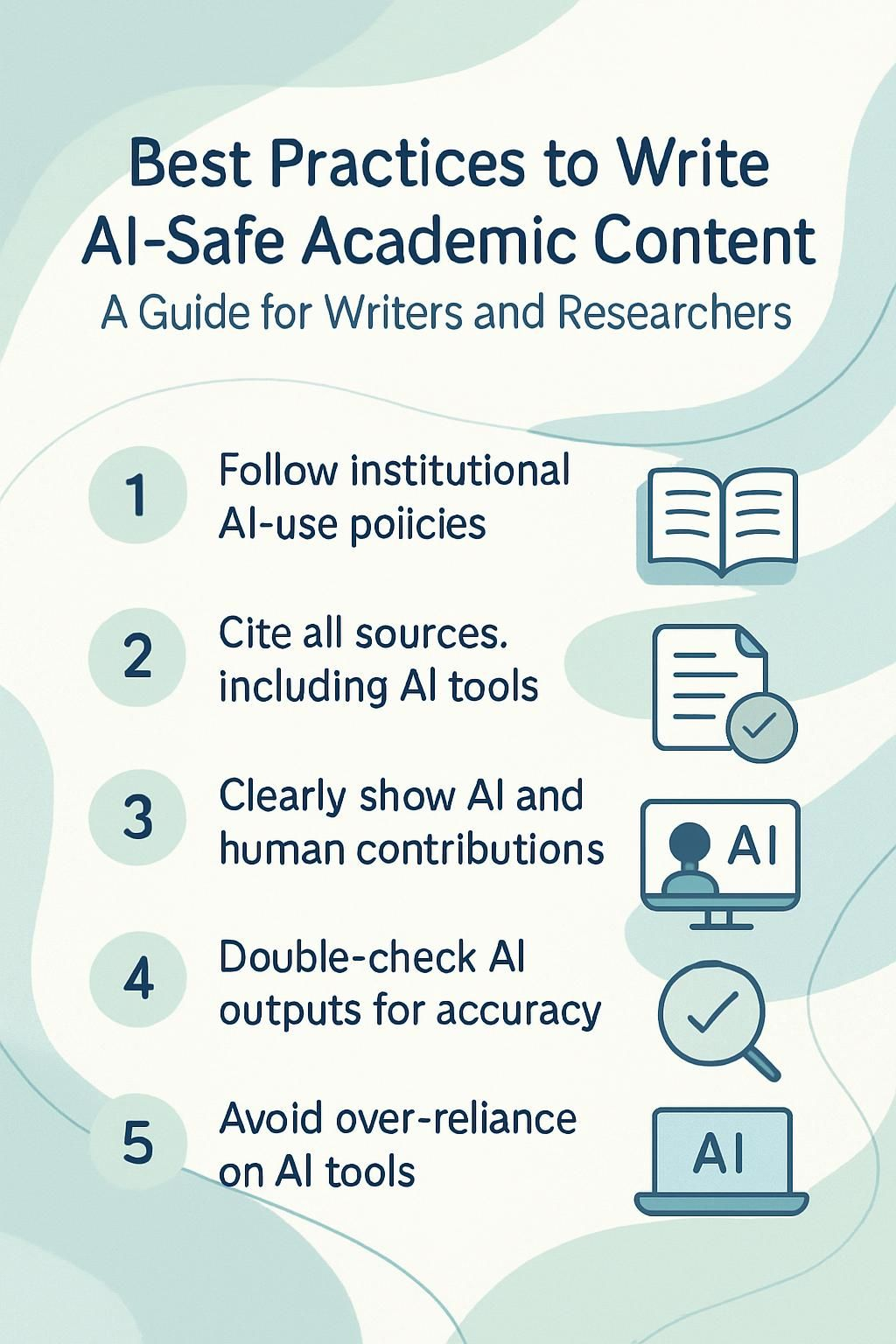
- Always follow institutional AI-use policies to avoid ethical issues. Cite all sources, including AI tools like ChatGPT or Research Rabbit, to maintain academic integrity.
- Be transparent about how you use AI in your work. Clearly show which parts are human-created and which are AI-assisted.
- Use AI tools like Grammarly and Semantic Scholar for grammar checks, research support, and organizing data but double-check for accuracy as errors are common.
- Avoid relying too much on AI; it cannot replace critical thinking or creativity. Review outputs carefully to find mistakes or biases in the content.
- Ethical writing relies on honesty and fairness while using tools responsibly. Following guidelines keeps trust intact with readers and institutions alike.
Understand Ethical Guidelines for AI Use
Using AI ethically starts with knowing the rules and sticking to them. Keep your work honest, clear, and free from shortcuts that harm academic integrity.
Adhere to institutional policies
Understand and follow your university’s AI rules to stay safe. Using generative AI without approval can lead to academic misconduct. Institutions often have clear policies about tools like ChatGPT or Microsoft Copilot.
Check these guidelines before starting any project.
Publishers now include clauses to protect authors’ work from unauthorized AI training. This helps creators in fields like writing, art, or voice acting avoid misuse of their content.
Stick to these policies for ethical academic writing and research integrity.
Avoid academic dishonesty
Cite every source, even AI-generated ones, to avoid plagiarism. Failing to do so can damage academic integrity and trust. Tools like Research Rabbit or Semantic Scholar help track references efficiently.
AI tools might generate fake citations or biased results, so verify all details thoroughly.
Respect intellectual property by not using others’ work without permission. Avoid pirate websites or unlicensed content that violates copyright laws. Proper licensing protects creators while ensuring fair use policies.
Academic dishonesty undermines credibility; honesty strengthens your work’s value.
Integrity is doing the right thing, even when no one is watching.
Maintain Transparency in AI Usage
Be open about using AI tools in your work, so trust stays intact. Share clearly how much was done by you and how much help came from the AI.
Disclose AI involvement in your work
Always state if AI helped in your work. Mention this in introductions, acknowledgments, or bylines. For example, Kindle Direct Publishing (KDP) requires writers to disclose any AI-generated content.
This keeps academic integrity intact and avoids confusion about authorship.
The Authors Guild even offers a “Human Authored Certification” mark for fully human-written books. Such transparency builds trust and credibility with readers. After explaining AI’s role, focus on how to clearly differentiate between human effort and machine output—a key step toward maintaining ethical writing practices.
Clearly differentiate human and AI contributions
Label each part of your content clearly. Human work reflects creativity, critical thinking, and emotional depth. AI-generated text often focuses on efficiency, structure, or repetitive tasks like summarizing data.
AI helps with tools; humans bring the soul.
Use generative AI for organization and editing. Avoid letting it shape unique arguments or original ideas. Let human input guide research interpretations while using AI to sort large datasets quickly.
Use AI Tools for Research Assistance
AI tools can speed up your research process, saving time and energy. They help you handle complex data tasks with ease, making your work smoother.
Streamline literature reviews
Research Rabbit can simplify literature reviews. It recommends academic papers and visualizes connections between studies. This saves time and ensures you find relevant research quickly.
Tools like Google Scholar provide access to vast databases for in-depth exploration. Large language models (LLMs) also help analyze extensive text data, spotting patterns or gaps in existing work.
Consensus offers a unique advantage by summarizing broader opinions on topics like medicine or economics. You no longer need to sift through piles of information alone. These tools make digging into the details less tedious while still supporting critical thinking skills essential for academic writing.
Organize and analyze data effectively
AI tools like Otio can process large datasets fast. It organizes research data, generates notes, and simplifies analysis. For instance, it helps researchers handle comprehensive studies without feeling overwhelmed.
Use this tool to sort complex data quickly while keeping track of key points.
Litmaps offers a visual way to study citations and links between research papers. With dynamic maps, you can spot patterns in seconds instead of hours. Semantic Scholar filters through millions of academic papers intelligently.
This makes finding relevant content easier and less time-consuming for anyone using AI in academic writing or critical thinking tasks.
Avoid Over-Reliance on AI
Don’t let AI do all the thinking for you—it can’t replace your judgment. Double-check facts and stay sharp, no matter how tempting shortcuts may seem.
Recognize AI limitations in critical thinking
AI struggles with tasks that need deep thinking or creativity. It processes data but cannot grasp emotions, abstract concepts, or human experiences. Large language models like ChatGPT 3.5 might generate convincing text, yet they lack true understanding or original thought.
Treat AI as a helper needing constant oversight. Blind trust in its output can spread false information or biased content. For instance, relying on AI for academic writing without fact-checking risks errors and misinterpretations.
Critical thinking remains a job only humans can do well; machines can’t replace that skill yet.
Verify AI-generated content for accuracy
AI-generated content may look polished, but it can include errors. Cross-check every fact or claim using trusted sources like Google Scholar or Research Rabbit. Large language models sometimes create fake references or biased data, which harms credibility.
Review citations carefully to avoid these issues.
Use common sense while evaluating AI outputs. If something seems off, dig deeper. Balance AI assistance with your critical thinking skills to spot any gaps or mistakes in the information provided.
This ensures academic integrity and trustworthy research writing.
Enhance Writing Quality with AI
AI can polish your grammar and tighten messy sentences. It helps make your ideas shine, keeping readers hooked from start to finish.
Refine grammar and style
Fixing grammar and polishing style makes writing clear and professional. AI tools like Grammarly or Google Translate spot errors fast. They offer real-time feedback, helping non-native speakers improve.
These tools suggest synonyms from options such as Thesaurus.com to sharpen vocabulary while keeping the text meaningful. Use them for copyediting, but always add your personal touch.
Don’t rely on AI-generated content blindly; read everything carefully afterward. Machines lack human intuition and can miss critical nuances in academic writing. Let AI assist you with structure or proofreading, but ensure the final version reflects your voice clearly without sounding robotic or forced.
Improve clarity and coherence
AI tools like large language models (LLMs) can transform unclear writing into crisp, readable content. They help refine grammar and style quickly, making sentences flow better. Non-native English speakers often benefit as AI offers instant feedback on sentence structure and word choice.
This helps keep the reader engaged without confusing jargon or clunky phrasing.
Using AI-generated text as a draft is smart. Writers can tweak it to match their tone while improving clarity during revision. Tools like Research Rabbit or Google Scholar streamline this process by suggesting related documents and insights for stronger arguments.
Combining these features ensures polished academic writing that’s easy to follow yet impactful.
Emerging Competitors in the AI Detection Market
The AI detection market is heating up, with new players challenging older systems. Tools like Research Rabbit and Google Scholar aim to help users detect AI-generated text more effectively.
Their features focus on identifying patterns in large language models like GPT-based systems. Some tools also specialize in targeting deepfake videos or fake news.
Adobe Firefly has stepped into this space too, although it’s better known for creating generative AI art. Competitors now prioritize ethical considerations and academic integrity due to rising privacy concerns.
With creators calling out mass copyright infringement by unlicensed training data in 2023, the Authors Guild advocates for change by promoting FAIRLY TRAINED CERTIFICATION as a standard for responsible AI use.
Conclusion
Writing AI-safe academic content is about balance. Use tools like Research Rabbit or Google Scholar for support, but keep your voice and critical thinking sharp. Be honest about how you use AI, and always follow ethical guidelines.
Stay curious, stay ethical, and let your ideas—not just the tech—shine bright.