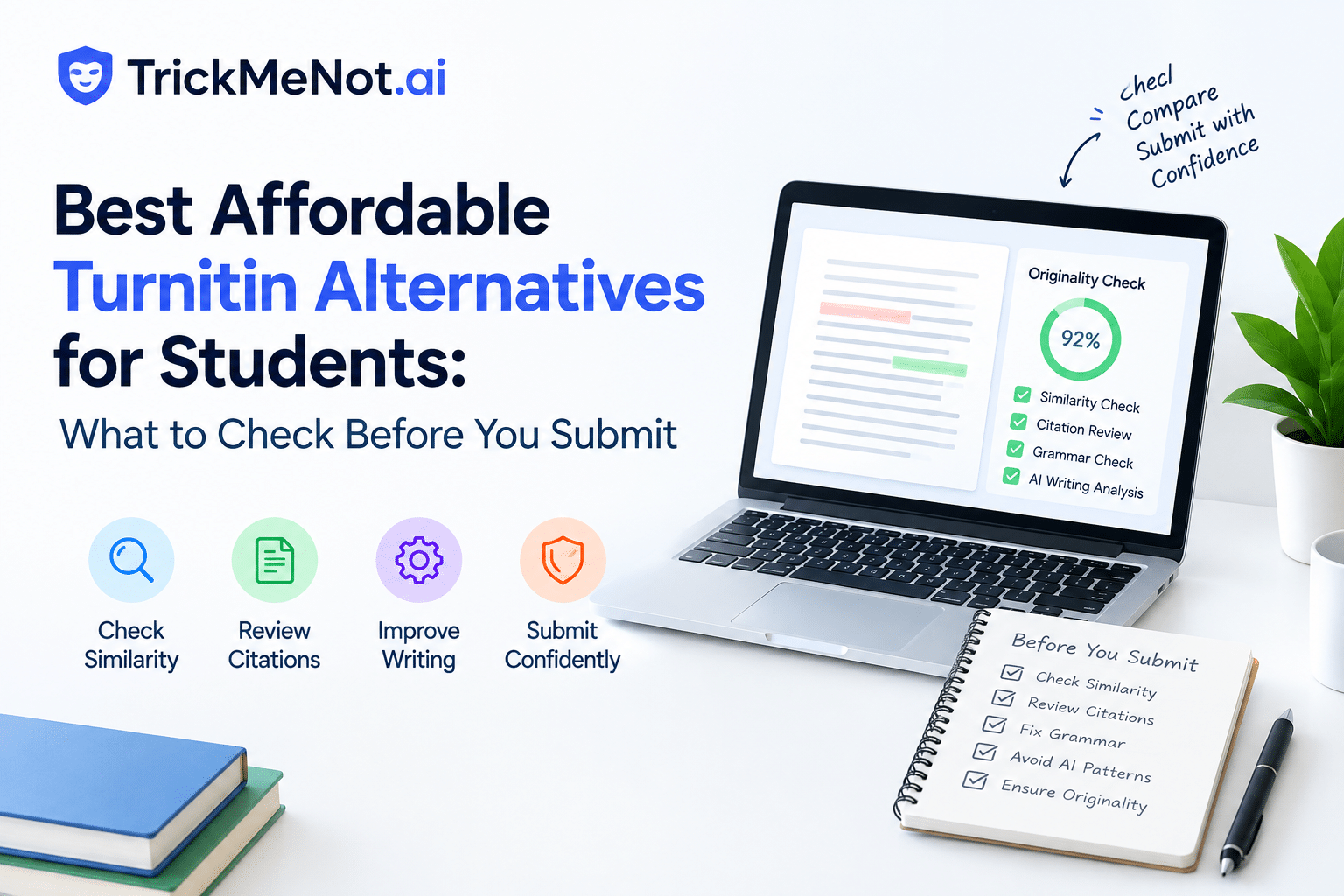
If you’re looking for an affordable alternative to Turnitin, start by understanding exactly what you need to check. Similarity checking, plagiarism review, citation accuracy, grammar improvement, and AI writing detection are different tasks—not one single score.
A third-party tool may help you review your writing before submission, but it shouldn’t be treated as a replacement for your institution’s official Turnitin report. Turnitin compares submissions against its own database, and its similarity score reflects matching text, not a final determination of plagiarism. Turnitin itself states that AI writing indicators shouldn’t be used as the sole basis for an academic decision.
The most useful approach: use a free Turnitin alternative to review your writing before submission, then follow your school’s actual academic integrity requirements.
- Why Do Students Look for Affordable Turnitin Alternatives?
- How to Choose an Affordable Turnitin Alternative
- How AI Writing Detection Works and Why Results Need Review
- A Practical Pre-Submission Checklist
- Free Tools Worth Using Before You Submit
- What Makes a Good Pre-Submission Review Process?
- Why a Single Score Shouldn’t Control Your Submission
- Frequently Asked Questions
- Final Thoughts
Why Do Students Look for Affordable Turnitin Alternatives?
Most students searching for an alternative are trying to solve one of a few specific problems:
- Identifying potentially similar text before a professor does
- Reviewing citations and quotations for accuracy
- Improving grammar and readability
- Checking whether paraphrased content is genuinely original
- Reviewing AI-assisted writing before submitting it
The catch is that these are different jobs, handled by different types of tools. A similarity checker looks for matching or overlapping text. An AI writing detector estimates whether text has characteristics associated with AI generation. A grammar or writing tool focuses purely on language and structure. Understanding this distinction helps you pick the right tool instead of chasing a single number.
What’s the Difference Between a Similarity Score and Plagiarism?
This distinction matters more than most students realize. A similarity score shows how much text matches or resembles material in a comparison database, it does not by itself prove plagiarism occurred. Properly quoted material, references, and common phrases all create matches that are completely legitimate. Turnitin explains that its report is meant to support human review and academic judgment, not replace it.
What to actually review instead of fixating on a percentage:
- Where the matching text appears
- Whether the source is properly cited
- Whether quotation marks are used correctly
- Whether a paraphrase genuinely reflects your own wording
- Whether a match comes from unavoidable, common language
A lower number isn’t automatically “better,” and a higher one doesn’t automatically mean wrongdoing. Context decides that, not the score alone.
Can a Free Tool Replace Turnitin?
Not exactly, and it’s worth being upfront about that. Different tools use different databases, detection methods, and reporting systems, so a result from another service shouldn’t be described as an official Turnitin score or guaranteed to match your institution’s report.
A more realistic way to think about it: independent tools are useful as part of a pre-submission review process, not a substitute for the report your school actually uses. If your draft still reads a little stiff after editing, running it through a free AI text humanizer can help before you get to the originality-checking stage, smoothing tone is a separate task from checking similarity, but doing both before submission catches more issues than doing either alone.
How to Choose an Affordable Turnitin Alternative
1. What does the tool actually check?
Before trusting any score, confirm whether the tool checks text similarity, web-based matches, citation issues, grammar, or AI-writing patterns. Don’t assume every “originality” score measures the same thing.
2. How transparent are the results?
A useful tool should show why something was flagged, highlighted sections, source references, and clear explanations beat a bare number with no context.
3. Does it support better writing, not just a better score?
The goal shouldn’t be gaming a number. A genuinely useful tool helps you spot repetitive wording, weak citations, and unclear sentences, improvements that matter regardless of what any detector says.
4. Is it honest about its limitations?
No detector is perfect. Turnitin itself acknowledges that AI detection can produce false positives, particularly at lower confidence ranges, and recommends human review alongside any automated result. A tool that’s upfront about this is more trustworthy than one claiming certainty it can’t actually deliver.
How AI Writing Detection Works and Why Results Need Review
AI detection tools estimate whether text has patterns associated with AI generation, that’s an estimate, not a definitive statement about how someone wrote something. Turnitin’s own guidance is explicit that its AI Writing Report is meant to support educators, not serve as sole grounds for action, and that lower-confidence ranges carry a higher risk of false positives.
If a tool flags part of your writing:
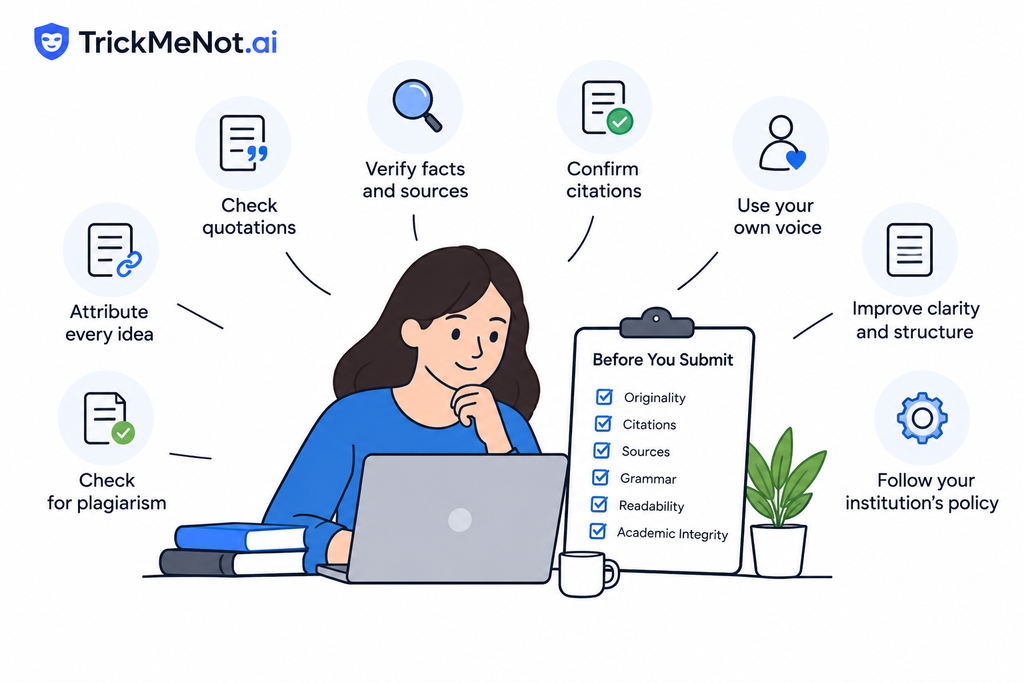
- Review the flagged section carefully
- Check that the ideas reflect your actual understanding
- Verify facts and sources
- Confirm citations are correct
- Rewrite unclear passages in your own genuine voice
- Follow your institution’s specific policy on AI assistance
The goal is improving authenticity and clarity, not trying to outsmart a detection system.
A Practical Pre-Submission Checklist
- Have I written or properly attributed every idea in this work?
- Are direct quotations clearly marked?
- Are sources cited in the required style?
- Does my paraphrasing genuinely reflect my own understanding?
- Have I checked factual claims against reliable sources?
- Is the structure clear and easy to follow?
- Have I reviewed grammar and readability?
- Does this follow my institution’s academic integrity policy?
- If AI assistance was used where permitted, have I followed disclosure requirements?
This process is worth far more than optimizing for a single percentage.
Free Tools Worth Using Before You Submit
Trickmenot AI offers a small set of tools built around exactly this pre-submission process, rather than any single score:
- Free Turnitin Alternative – get an early originality estimate before your actual submission
- Free Text Humanizer – smooth out mechanical or repetitive phrasing before your final read-through
- Free Essay Writer – useful earlier in the process if you’re starting from a blank page rather than reviewing an existing draft
- AI Humanizer Tools Directory – a comparison resource if you want to weigh multiple tools by pricing and use case before choosing one
Whatever tool you use, review the final output carefully for factual accuracy, proper attribution, and consistency with your institution’s requirements – no tool replaces that step.
What Makes a Good Pre-Submission Review Process?
Step 1 – Review your research. Confirm sources are reliable, claims are accurate, and citations actually support what’s being said.
Step 2 – Check structure and clarity. Does the intro clearly frame the topic? Does each section have a clear purpose? Does the conclusion actually answer the question?
Step 3- Review originality and attribution. Quotes marked correctly, sources cited, paraphrasing accurate, references complete.
Step 4 – Improve readability. Watch for repetitive phrasing, overly complex sentences, and inconsistent tone.
Step 5 – Submit according to your institution’s actual requirements. Citation style, similarity thresholds, and AI-tool policies vary – always defer to your specific course or school.
Why a Single Score Shouldn’t Control Your Submission
The common mistake is treating a similarity or AI-detection percentage as pass/fail. That ignores context entirely. Turnitin is explicit that its similarity score reflects matching text and needs human review, and that AI-writing results aren’t definitive in isolation.
A better question to ask before submitting:
Does my work accurately represent my own understanding, properly credit its sources, and follow the academic rules for this specific assignment?That standard holds up better than any single number ever will.
Frequently Asked Questions
What is an affordable Turnitin alternative?
An affordable Turnitin alternative can help you review text similarity, citations, and other writing issues before submitting your work. However, it should not be treated as a replacement for your institution’s official Turnitin report.
Can a free Turnitin alternative replace Turnitin?
No. Free tools can be useful for pre-submission review, but they may use different databases, methods, and scoring systems than Turnitin.
Is a similarity score the same as plagiarism?
No. A similarity score identifies matching or similar text. It does not automatically determine whether plagiarism has occurred. The context, citations, quotations, and academic rules must also be considered.
Can AI writing detectors be completely accurate?
No AI writing detector is perfect. Automated results can contain errors, so flagged content should be reviewed carefully rather than treated as a final academic judgment.
What should students check before submitting an assignment?
Students should review citations, quotations, paraphrasing, factual claims, grammar, readability, originality, and their institution’s academic integrity requirements.
Should I use an affordable Turnitin alternative before submission?
Yes, it can be useful as an additional pre-submission review step. However, always follow your school’s or institution’s official requirements and policies.
Final Thoughts
Finding an affordable Turnitin alternative isn’t really about finding a tool that spits out a percentage, it’s about building a reliable pre-submission habit: reviewing your research, checking citations, catching mechanical phrasing, and following your institution’s actual requirements. Use tools like a free Turnitin alternative and free text humanizer as review assistants, understand what they can’t tell you, and treat the final read-through as yours to own, not the tool’s.