AI detectors and plagiarism checkers are often mentioned together, especially when students are reviewing assignments before submission. However, they are designed to look for different things.
A plagiarism checker generally looks for similarities or matches between submitted text and existing sources. An AI detector analyzes writing patterns to estimate whether text resembles AI-generated writing.
Understanding the difference can help students interpret automated results more carefully and choose the right type of check for their writing.
AI Detector vs Plagiarism Checker: Quick Answer
The main difference is what each tool is trying to identify.
An AI detector analyzes characteristics of writing that may resemble AI-generated text.
A plagiarism checker looks for similarities between submitted content and available sources.
A similarity result does not automatically mean plagiarism, and an AI detection result should not automatically be treated as proof that a text was generated by AI.
These tools answer different questions and should be reviewed separately.
What Is an AI Detector?
An AI detector is a tool that analyzes written content for patterns associated with AI-generated text.
Depending on the system, it may evaluate aspects such as wording, sentence patterns, predictability, and other characteristics of the writing.
The tool then produces an indication or score intended to show how closely the text resembles writing generated by an AI system.
Different AI detectors can use different methods, which means the same text may not receive identical results across multiple tools.
What Is a Plagiarism Checker?
A plagiarism checker is designed to identify similarities between submitted writing and existing content.
Depending on the tool and its available sources, it may compare text against websites, publications, documents, databases, or other indexed material.
The purpose is generally to help identify passages that may need closer review.
A match does not automatically mean that plagiarism has occurred.
For example, a correctly quoted passage with a proper citation can still produce a similarity match.
Students should therefore review the actual matched content instead of interpreting a percentage by itself.
AI Detection vs Plagiarism Detection
The simplest way to understand the difference is to consider the question each tool asks.
| Tool | Main question | What to review |
| AI detector | Does the writing resemble AI-generated text? | AI-writing indicators and highlighted sections |
| Plagiarism checker | Does the writing resemble existing sources? | Matches, sources, quotations, and citations |
| Similarity checker | How much submitted text matches available sources? | Individual matches and their context |
| Citation checker | Are sources and references properly documented? | Citations and reference details |
These tools can complement each other, but they are not interchangeable.
AI Detection Is Not the Same as Similarity
One common mistake is assuming that AI-generated text must also be plagiarized.
That is not necessarily the case.
AI-generated text can be newly generated and therefore may not directly match an existing source.
Likewise, human-written academic work can contain similarity matches because it uses quotations, common terminology, definitions, or properly cited source material.
This is why students should separate the concepts of:
AI detection → writing-pattern analysis
Similarity detection → source-text matching
Plagiarism review → evaluating whether source material has been used appropriately
What Does a Plagiarism Score Mean?
A similarity or plagiarism-related percentage should be interpreted in context.
A higher similarity percentage does not automatically mean that an assignment contains plagiarism.
Students should examine:
- Which passages were matched
- Where the matches came from
- Whether quotations are properly marked
- Whether sources are cited
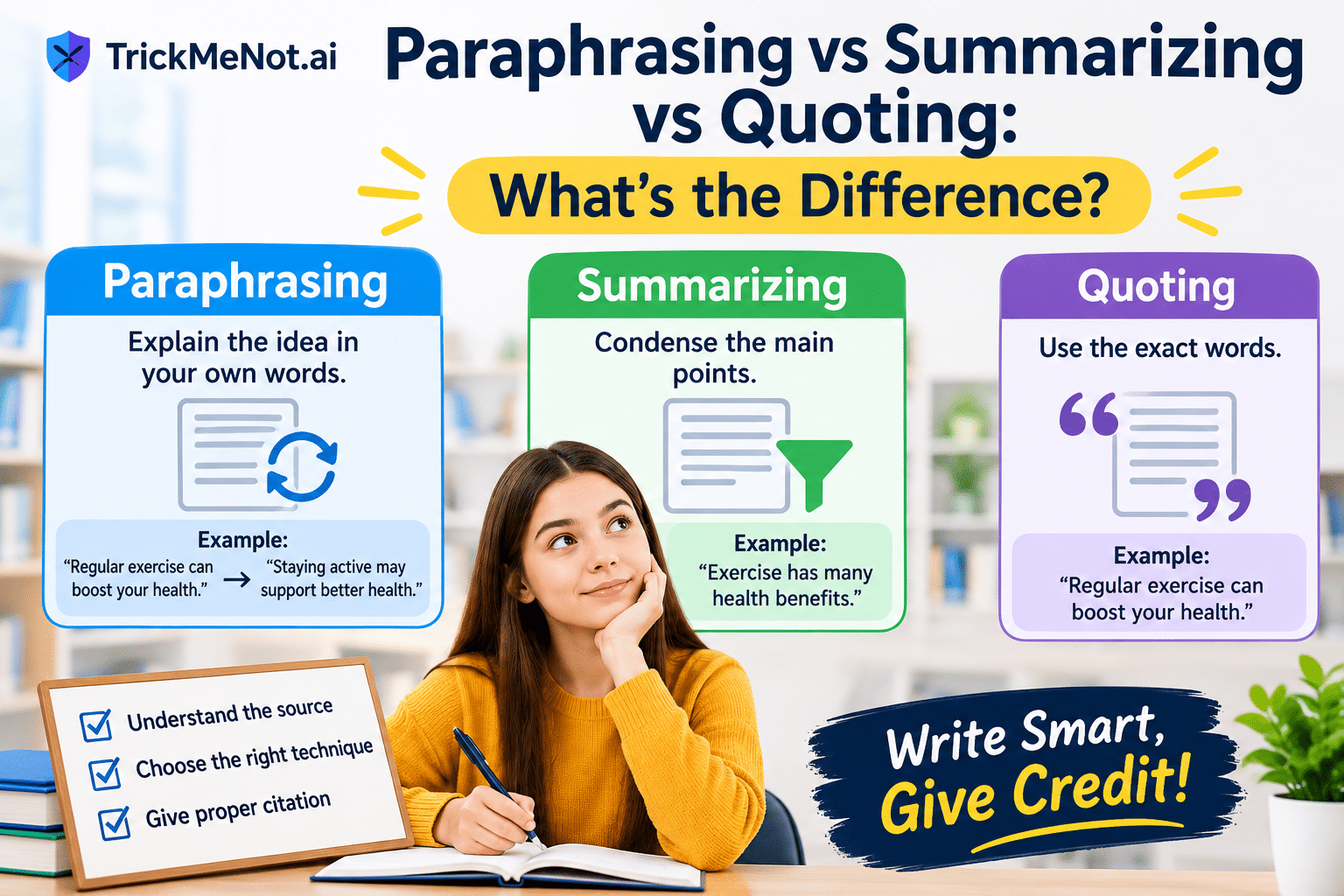
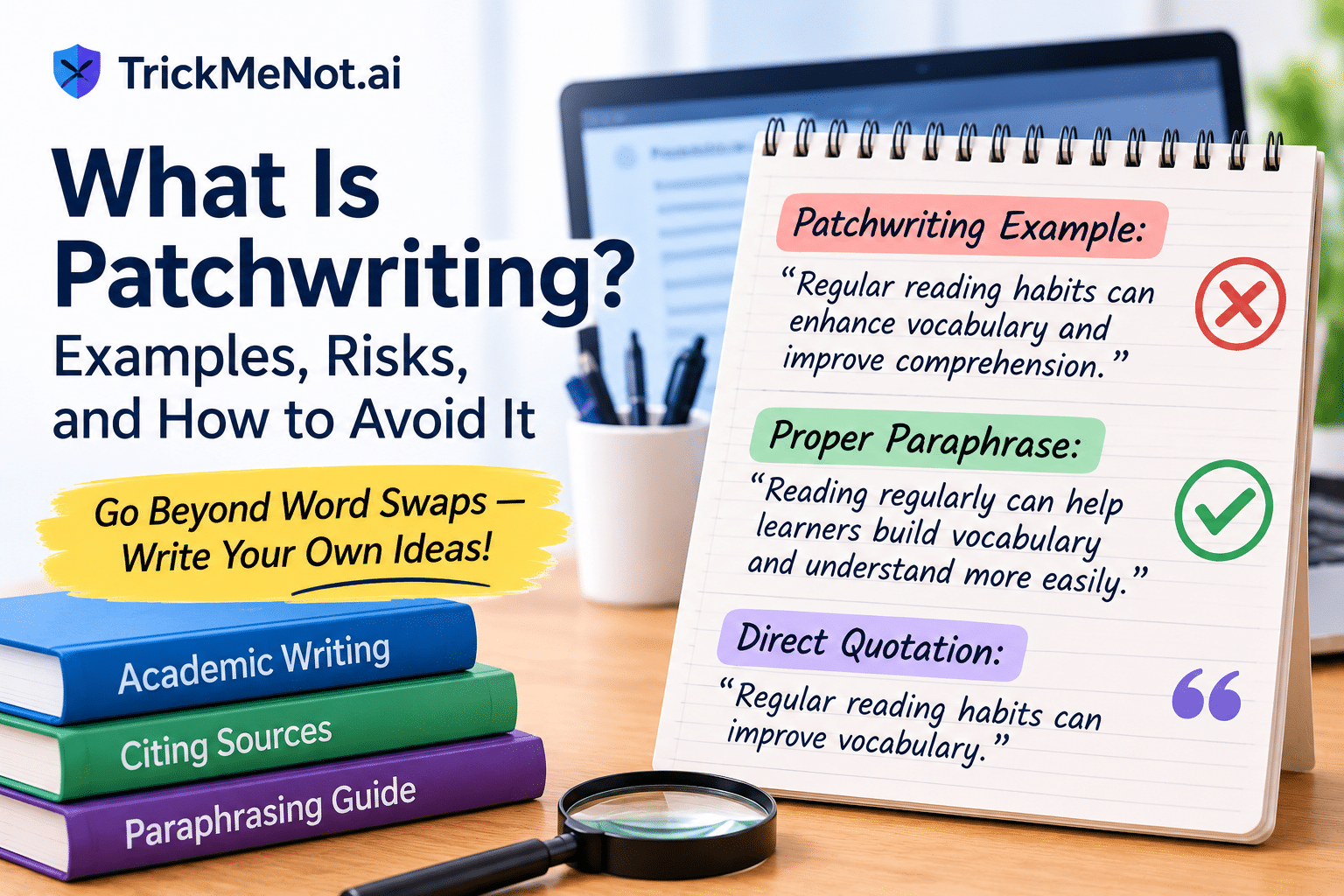
- Whether paraphrasing is appropriate
- Whether common phrases account for some of the matches
Your earlier article, Free Turnitin Alternatives for Students: What You Can Actually Check, covers this pre-submission review process in more detail.
What Does an AI Detection Score Mean?
An AI detection score is different from a similarity score.
It represents an assessment generated by an AI detection system based on characteristics of the submitted writing.
Students should not assume that the number alone explains how or why particular sections were identified.
Instead, review the writing itself.
Look for:
- Generic explanations
- Repetitive wording
- Unsupported claims
- Missing evidence
- Incorrect information
- Unclear reasoning
- Sections that need stronger personal analysis or examples
The objective should be improving the quality of the assignment rather than simply trying to change a numerical result.
Can a Plagiarism Checker Detect AI Writing?
Not necessarily.
A traditional plagiarism or similarity checker and an AI detector perform different types of analysis.
A plagiarism checker can identify similarities with available sources, but that does not mean it can reliably determine whether the writing was produced by an AI system.
Some platforms provide both similarity and AI-writing features, but the functions should still be understood separately.
If you are comparing tools, check exactly which features are included rather than assuming that every plagiarism checker provides the same AI detection capabilities.
Can an AI Detector Detect Plagiarism?
An AI detector is not a replacement for a plagiarism or similarity check.
Its primary purpose is to analyze writing characteristics associated with AI-generated text.
If a student needs to review potential source overlap, citations, quotations, and paraphrasing, a similarity or plagiarism check is more directly relevant.
For broader pre-submission review, students may use different checks for different purposes.
Why Students Confuse These Tools
The confusion often comes from websites that advertise several writing checks together.
A single platform may include:
- Plagiarism checking
- Similarity checking
- AI detection
- Grammar checking
- Citation tools
- Writing assistance
Having multiple features in one platform does not mean that all of these checks measure the same thing.
Before using a tool, students should identify the specific feature they need.
Which Check Should Students Use?
The answer depends on what you are trying to review.
If You Want to Check Source Similarity
Use a similarity or plagiarism checker.
Review the matched passages and their sources.
If You Want to Review AI-Writing Indicators
Use an AI detector.
Treat the result as an indicator that requires context rather than as the entire explanation of the writing.
If You Want to Review Citations
Check whether claims, quotations, and borrowed information have been properly documented.
If You Want a Broader Pre-Submission Review
Use a combination of relevant checks and manually review the final assignment.
This approach gives students more context than relying on one automated score.
AI Detector vs Plagiarism Checker for Students
For students, the biggest practical difference is the type of problem each tool can help identify.
A plagiarism or similarity check can help you find source overlap that needs review.
An AI detector can provide an indication about whether certain writing patterns resemble AI-generated content.
Neither check replaces careful academic writing practices.
Students should still:
- Research information carefully.
- Use appropriate sources.
- Cite borrowed information.
- Review quotations and paraphrasing.
- Verify important facts.
- Follow their institution’s AI policy.
- Read and edit the final assignment themselves.
How Turnitin Alternatives Fit Into This
Students searching for a Turnitin alternative may encounter tools that combine several writing checks.
However, it is important to identify what the alternative actually provides.
Some tools may focus primarily on similarity checking, while others may offer AI-writing analysis, citation-related features, or additional writing tools.
Your Free Turnitin Alternative can be used as part of a broader pre-submission workflow.
For a more detailed comparison of Turnitin alternatives and plagiarism checkers, read Turnitin Alternative vs Plagiarism Checker: What’s the Difference?.
A Simple Student Workflow
A practical workflow can look like this:
Write → Research → Cite → Check Similarity → Review AI-Writing Indicators → Verify Facts → Edit → Final Review
Each step addresses a different part of the writing process.
For example, a similarity check can help identify source overlap, while an AI detector can provide a separate writing-pattern assessment.
Students should then review the actual content instead of focusing only on percentages.
Common Mistakes to Avoid
1. Assuming Similarity Means Plagiarism
A similarity match needs context.
Quoted and correctly cited material can still appear as a match.
2. Assuming AI Detection Proves AI Use
An AI detector produces an assessment based on its own analysis. Students should review the result alongside the actual writing and other relevant information.
3. Comparing Percentages Directly
An AI detection percentage and a similarity percentage represent different types of measurements.
They should not be treated as equivalent.
4. Ignoring the Sources
If a similarity tool identifies a match, students should inspect the source and determine whether the material has been used appropriately.
5. Ignoring Academic Policies
Before using AI writing or editing tools, students should understand the rules that apply to their assignment or institution.
Should You Use Both an AI Detector and a Plagiarism Checker?
They can be useful together because they address different questions.
A similarity or plagiarism check can help students review source overlap.
An AI detector can provide an additional perspective on whether the writing contains patterns associated with AI-generated text.
Using both does not guarantee that an assignment is academically correct or acceptable.
The final review should still include sources, citations, facts, argument quality, writing clarity, and the relevant academic policy.
Other Writing Tools Students Can Explore
Students working with AI-assisted writing may also use tools for drafting and editing.
For drafting assistance, see the Free Essay Writer.
For editing AI-assisted text, see the Free Text Humanizer.
If you want to compare different AI humanizer platforms, explore the AI Humanizer Tools Directory.
Each tool serves a different purpose, so students should choose based on the specific stage of their writing process.
FAQ
Is an AI detector the same as a plagiarism checker?
No. An AI detector analyzes writing patterns associated with AI-generated text, while a plagiarism or similarity checker looks for relationships between submitted text and existing sources.
Can plagiarism checkers detect AI-generated content?
A plagiarism checker primarily focuses on similarities with available sources. AI-writing detection is a separate type of analysis.
Can AI detectors detect plagiarism?
AI detectors are not designed to replace plagiarism or similarity checking. Students should use a relevant similarity or plagiarism check when reviewing source overlap.
Which is more important: AI detection or plagiarism checking?
They address different issues, so they should not be treated as competing versions of the same check. The appropriate check depends on what the student needs to review.
Does a high similarity score mean plagiarism?
Not automatically. Students should inspect the matched passages, sources, quotations, citations, and context before drawing conclusions.
Does an AI detection score prove that text was written by AI?
An AI detection score is an automated assessment from a particular tool. Students should interpret it carefully and review the underlying writing and context.
Should students check both before submission?
Depending on the assignment and institutional requirements, students may use both types of checks as part of a broader review process.
Final Thoughts
AI detectors and plagiarism checkers may appear similar because they are both used when reviewing written work, but they examine different aspects of content.
A plagiarism or similarity checker focuses on relationships between submitted text and available sources. An AI detector focuses on patterns that may resemble AI-generated writing.
Understanding this distinction helps students interpret automated results more carefully.
Instead of relying on one percentage, review the actual writing, sources, citations, facts, and relevant academic requirements before submitting.
For students looking for additional pre-submission resources, start with the Free Turnitin Alternative and explore the other academic writing tools available on TrickMeNot.ai.